on culture, politics, education, religion, family, and a host of other topics
Author: Stephen W. B. Rizzo
I am a Christian who is flawed but forgiven. I am a father who is blessed beyond measure with two amazing children. I am an educator who is fortunate to get paid for doing what he loves. I am a writer, a budding photographer, and a musician who really needs to practice more.
If you know the sweet flavor of cooked onions, you can already imagine how delicious this simple breakfast dish is.
If you think you do not like onions, that is because you have only been exposed to raw white onions on a hotdog at a bad hotdog stand.
This version of the recipe is mine, but the idea occurred to me from a reel I encountered when scrolling on Facebook. I didn’t stop to view it. I was already hungry and that little nudge was all I needed to decide what breakfast should be today.
Ingredients: Olive oil Eggs Sausage or other meat Grated cheese of choice Onion Peppers of choice Garlic Salt Ground black pepper (Other ingredient options, such as mushrooms or tomatoes, are only limited by your imagination and pantry.)
Prep: Set your shredded cheese out and let it come to room temperature while you work on the other ingredients. This will allow it to melt faster when you begin cooking.
Rinse and cut off the top and remove the seeds from the peppers. I had one Marconi and one Sweet Banana Pepper from the garden. For more heat, you might choose Jalapeño or Serrano. You know what you like or what you have handy. I decided on these peppers because they were the peppers I had in my garden, but they worked well together.
Mince the peppers. In addition to providing flavor and potentially heat, the peppers provide texture, so don’t cut them too small.
Mince a small bit of the onion, roughly an amount equivalent to one pepper, also purely for the sake of texture.
Mince one to two cloves of garlic.
Every type of onion brings its unique flavor to this dish. Today I used a red onion because I had one on hand. Then again, I usually do have one on hand because I like cooking with them. Goldie Locks would agree. They have just enough punch to taste oniony, but mildly so, when raw. Cooked or raw, they have a gentle sweet flavor, which holds up well when cooked, so they tend to be my go-to onion. But to each his (or her) own, white, yellow, or any other variety would work.
More than thirty years of teaching have taught me that some things that should not have to be said frequently have to be said — Peel the onion.
Next, cut the onion horizontally into a quarter or half inch rounds. After cutting the onion into rounds, take each slice and gently push out the individual layers. Each slice will naturally have rings that can be separated by lightly pressing them apart with your fingers. The rings will vary in size. Decide which size rings you want to use, or use a variety of sizes if you wish.
By the way, unless you are cooking for an army, you will have more than half of the onion left. Fortunately for me, Monday is Labor Day, so the remainder will be used with burgers and hotdogs. Onion slices will keep well for a few days stored in the refrigerator.
If you have read any of my cooking narratives, you know that part of the process is using what you have on hand instead of running to the store for ingredients. Earlier in the week I made cheese greets with Italian sausage. I had one sausage left, so I crumbled it. But you can use cold cuts or bacon or even omit meat. If you are working with uncooked meat, especially pork, cook it before you mix it with the eggs. The cook time for the eggs will not be long enough for uncooked meat to cook adequately.
I was making enough for the family, my band of Three Musketeers (and sometimes Three Stooges), so I used five eggs. Crack them into a small mixing bowl and whisk. Whisking not only mixes the whites and yolks, it aerates, creating a fluffy texture. Next, combine the other ingredients. Salt and pepper to taste. If you are not sure how much salt or pepper, you could wait until you begin to cook the eggs for salt and pepper if you prefer or even wait until they are cooked.
Salting tip: You should use just enough salt to bring out the flavors. You never want to taste the salt. As for pepper, I like lots of ground black pepper. I have my mother’s palette. She virtually covers her eggs with black pepper.
Add the shredded cheese and continue to mix. (I did not have any shredded cheese in the fridge, but I did have sliced Colby Jack. I tore two slices into small pieces, which worked fine.)
Cook: Once the egg mixture is prepared, add olive oil to a skillet and heat. I usually turn the heat up high and then back down after the oil heats up. There is no particular culinary reason that I know of for this. It has more to do with my impatience. Once the oil is hot, turn the heat to medium low.
Take the skillet off the heat to add the onions. This will reduce the likelihood of the oil popping on you. (I experimented with a couple of techniques. This one worked the best.) Your onion rounds will have a bit of a funnel shape because of the natural shape of the onion. Place them in the oil with the larger aperture facing up. Return to heat. If you notice, the onions will begin to gently change color and texture from the bottom up as they cook. After about twenty to thirty seconds, flip. Cook for twenty or thirty more seconds, depending on the size of the slice, and then flip again. You don’t want to brown them. Just barely begin the caramelization process.
With the funnel end up, add the egg mixture inside the rings. For this, I used a gravy ladle. I coated it with oil to keep the eggs from sticking. I have no idea if coating with oil really made any sense or helped, but using the ladle was more manageable than pouring from the mixing bowl. Be careful not to overfill the rings. If you do, eggs will spill out into the skillet as you cook. (Yes, I learned this from experience today.) Some might seep underneath the rings also. That’s ok. Just gently pull them away from the rings before you try to flip them.
Skillet tip: Use a griddle or at least use a shallow skillet to make maneuvering the rings easier while they cook. Also, do not place too many rings in the skillet at the same time. It makes it harder to individually flip them without bumping the others and spilling the egg mixture.
Let the eggs cook. When there is just a slight bit of uncooked egg left on top, flip the rings. I settled on a small, thin spatula. From my several attempts, it worked better than a larger or thinker spatula. Let them cook just long enough for the remaining uncooked egg to get done or cook longer if you want the egg to brown a little.
Plating: Remove from oil and place on a plate. It will not take them long to cool enough to eat.
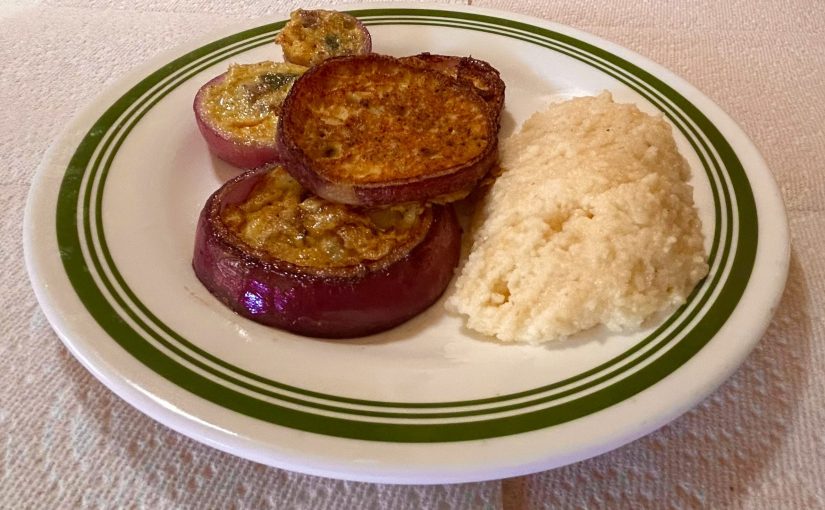
I plated the onion ring eggs with some of the leftover grits from the cheese grits and Italian sausage from earlier in the week. (Plated, I sound so fancy.) The grits were not watery instant grits. They were rich and thick with cheese, butter, and chicken stock and paired nicely with the onion rings and eggs. (Paired nicely, yep, my diction is definitely getting fancier.)
The onion rings and eggs were delicious, and I ate more than my share!
Postscript: Did you know that due to their high fructan content, a type of carbohydrate that can cause gas and bloating, eating too many onions can cause a tummy ache? Yeah, I learned that from experience today too. But it was worth it.
Last Saturday morning, I let myself sleep in. Correction, I made myself sleep in. The first week of the semester always disrupts my circadian rhythm. I had gotten four, no more than five hours, sleep every night for a week. And true to form, I woke up at 3 a.m. but put myself back to bed at 5 a.m. for a few more hours. Even after I got up, I was moving slowly, so no breakfast. And then once lunch rolled around, I wanted something good. But I did not want to go to the store or any great trouble.
And then there it was, inspiration, a single Ichiban eggplant lying on the table.
With the eggplant in my mind, I scanned the fridge and came up the following tasty lunch idea.
Ingredients: Eggplant Bell pepper Carrot Onion Garlic Oregano Olive oil Red pepper flakes Salt Lemon juice
Prep: I recently learned a French culinary term from a TikTok video – mise en place (pronounced meez awn plahz), which literally translates to “everything in its place.” This is good advice. But I don’t speak French, so I’m just going to say before you begin cooking, make sure you have everything in place – all the veggies peeled and cut, skillet ready, everything.
Peel the eggplant. You don’t have to, but I prefer peeled. Then cut it into small pieces, in this case, about half inch rounds. Toss the eggplant into a bowl of salt water to soak while you prep the other ingredients. The saltwater helps pull some of the bitter taste associated with eggplant. Fresh eggplant is less likely to have the bitter taste, but soaking them in the salt water is still a good idea.
Peel and cut the carrot(s) into about quarter inch pieces. (I like large carrots. They tend to be sweeter. The one I had was about a two-inch circumference. So I peeled and quartered it and then cut it into pieces.)
Rough dice half an onion. (In this case I had a yellow onion, but any kind works.)
Core the bell pepper and dice. (My bell pepper was yellow, but like the onion, whatever you have on hand is fine.)
Mince two to three cloves of garlic (Pre-minced garlic works if you don’t have whole garlic.)
Cook: Preheat your skillet to medium low heat and add olive oil.
Add the carrots and lightly salt. As you add the other ingredients, add additional salt and olive oil as needed. Be sparing with the salt, but don’t be stingy with the olive oil.
Cook for about three minutes and then add the onions and eggplant. Stir as you add each ingredient.
Continue cooking and add the bell pepper after about three more minutes.
Finally after a few more minutes, add the garlic and two tablespoons of oregano, not that I actually measure. Add the red pepper flakes to taste for a little heat.
For crispier vegetables, don’t cover as you cook. If you prefer the vegetables to break down more, then cover with a lid in between stirring. Just before you take the veggies off the heat, hit them with a little lemon juice. The acid of the lemon balances the oil and overall brightens the flavor of the veggies. (Confession, sadly I forgot to do this. But I use this tip enough to know what the effect would have been. I will definitely remember next time.)
When you are satisfied with the consistency, serve over rice or pasta.
Plating: I had leftover spaghetti in the fridge, so I heated it up and spooned the veggies over the spaghetti and sprinkled with grated Parmigiano Reggiano.
Continuing with the theme of what’s on hand, I heated up some ground Italian sausage from earlier in the week and added a sliced tomato and basil fresh from the garden.
I must say, it was all yummy.
Now go be creative with what you have at the house. You might just surprise yourself.
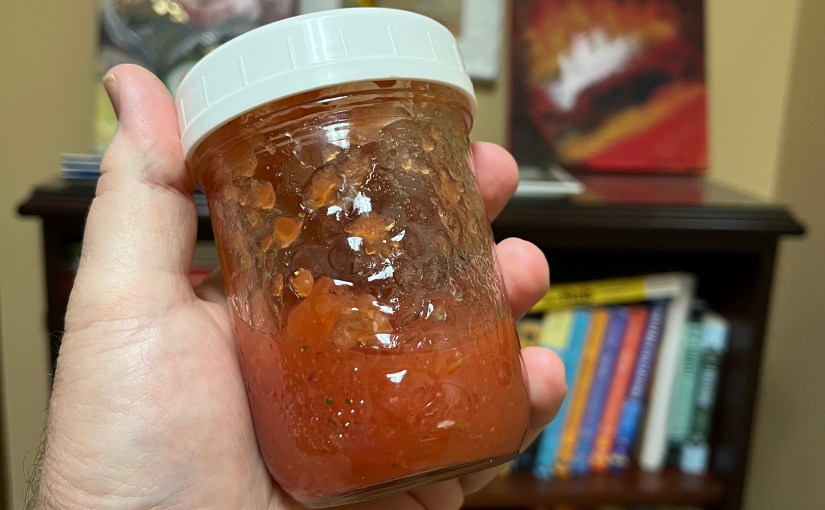
Today for lunch, my daughter Olivia and I are having taco salad with homemade leftover salsa that I whipped up last night. My son Nick is in Atlanta on a video/photo shoot and is probably going to eat somewhere fancy, but I doubt it will top our lunch because this quick and easy homemade salsa is even better the second day than it was last night.
Speaking of last night, we had a bit of confusion about dinner. I had told Nick I would make spaghetti sauce this week and sent him to the store for groceries, but I forgot I had told Olivia we could have taco salad. Nick purchased groceries for sauce but had did not get salsa, of course, and we did not have any on hand. So, I pulled a can of diced tomatoes from the groceries Nick had purchased for spaghetti sauce and then went to the pantry to see what else I could find to save a trip back to the store for salsa. In the process, I came up with this “quick and easy” salsa.
Prep time: 10 minutes/Feeds: 2 to 5
10-ounce can diced tomatoes with chilies (mild or hot) 14.5-ounce can diced tomatoes Half a chopped onion (I had a red onion at the house, but I think a white onion would be better.) 1 or 2 garlic cloves or a teaspoon (more or less) of ready-to-use minced garlic Cilantro to taste (We had dried, but fresh cilantro would kick the flavor up a notch.) Juice from a lime or 2 tablespoons of bottled lime juice (I did not have a lime and did not measure the bottle lime. I just eyeballed it. Use enough to give the salsa a touch of citrus.)
Blend to desired consistency with a food processor or hand emulsion blender.
It is that simple! And it really is tasty.
The next time you forget the salsa or if you just feel adventurous, open the cabinet and put this homemade salsa together. Experiment with your favorite ingredients. You might never go back to store bought salsa again.
My Uncle Edgar Morgan got hurt working in the coal mine. He was actually my father’s uncle, which made him my grand uncle. He and Aunt Martha lived in the town of West Jefferson. They had several daughters, Joy, Faye, Joanne, Marie, and Carol Jane. Marie was about my age. We were probably in the fourth grade when Uncle Edgar was hurt. He broke his back and was in the hospital for a long time. When he came home, he was confined to a hospital bed and wheelchair.
I remember going to visit him after his accident. Of course, I had been around them before, but this was my first time to go to their house in West Jefferson. Along with me were my two baby brothers Floyd and Lloyd, my mama and my daddy, Granddaddy and Granny Burton, and my daddy’s younger sister Helen Burton. Uncle Edgar was Granny Burton’s brother. My granddaddy and granny didn’t have a car for a while, so my daddy drove them.
That was the first time I or any of the rest of us, for that matter, had ever seen anything like the tree in their front yard. It was glorious. It was bushy. It had a base and then limbs branched out with these pretty pink fuzzy blooms on them. We had never seen anything like it! We all liked it. Aunt Martha said it was a mimosa tree. (I think it has a Japanese origin.) Granny was always getting cuttings off everything, so she and Mother got cuttings from the tree and rooted them.
Mama set one out in the front yard. It grew and was so pretty. Then after a while, mimosa trees just sprouted up everywhere. They tried to trim them down. But they kept coming up and coming up. They tried to get rid of them but couldn’t get rid of them. They just kept getting in everywhere.
Granny already had kudzu, another invasive plant from Asia, in her backyard that would start growing before the grass got high enough to be mowed. She also had a scuppernong vine that the kudzu would get intertwined with. Then she planted two mimosa trees in the backyard. The mimosa trees spread at my granny’s like they did at our house, so they came up in the scuppernong vine also. They tried to cut the kudzu and mimosa trees out of the scuppernong, but they could hardly cut anything without cutting the good scuppernong vine also.
My daddy finally cut down the tree in our front yard. But that didn’t kill it. It kept sprouting from the stump. I especially remember how Mother fought the tree stump because it kept sprouting up again, so she kept trying to kill the stump with anything that she had that she could. Anything like hot grease or hot water or anything that had lye or something in it, she’d go out there and pour it on the stump. But it still just kept growing and growing and growing till finally she killed it enough to the point that they could take it out of the ground with a tractor. We didn’t have big equipment, just the little red and white Ford garden tractor. But Mother had finally managed to get it to the point they could pull the roots and everything out of the ground. But it took years to get it to that point.
Now almost eighty years later, mimosa trees grow all over this area. When we moved here, we moved into almost a wilderness area that had no mimosa trees. We lived in the woods like Little House on the Prairie, so I figure that it’s the cuttings Granny and Mother got from Aunt Martha that are responsible for all of these Mimosa trees around us.
I think there’s a spiritual lesson here. Sin may look beautiful at first. It’s enticing, so much so that you bring it home and make a place for it. You even cultivate it. But then when it starts to take root, it’s hard to get rid of it. And even if you do get your life right with God, what you bring into your life you also bring into your family. Just like the mimosa trees that are all over this area now, you could be letting something take root that will be a problem for your family for generations. So if you see a mimosa tree, leave it where it is. And when you’re tempted to bring sin into your life, no matter how appealing, leave it alone too!
I was a little girl of only five years old. I had not started school yet. I had a father and a mother and twin brothers who were seven months old. I was happy with my family and loved them very much, and they loved me.
My parents had been Christians all my life. I never knew any kind of life except going to church regularly with my parents and grandparents. All my life my parents taught me the Word of God. The first book I ever owned was a Bible storybook. My parents read me stories from the book and every night had family prayer. My mother or father would say, “It’s your time to pray.”
And then I would begin to pray: “Now I lay me down to sleep; I pray the Lord my soul to keep.” This was something I was accustomed to doing every night before I went to bed.
My dad purchased forty acres of a farm in 1945. This was during World War II. The property was surrounded by woods on every side. He built a house on the property in the middle of the woods and moved our family into it. It was not a large house. But there was room for our family in it. Because the house was far off in the woods, it did not have a paved road that came to it, only a dusty dirt road. During the war, materials like copper that were needed for electrical wires were not available. So it would be several years before the house would have electricity.
Even though it was the middle of the 20th century, the family lived like pioneers from the 1800s. Mother cooked on a wood-burning stove and washed clothes by hand. At night, the house was lit by kerosine lamps and heated by a fireplace.
One day in March, I was having breakfast. Wearing a nightgown and little cloth house shoes, I sat at the kitchen table. Mother had mixed together butter and syrup, and I was sopping it up with a homemade biscuit. One little brother was sitting beside me in a highchair. The other little brother had spent the night at my grandmother’s house. I noticed that my mother kept going to the doors and windows and looking out. But that did not disturb me. I was just having breakfast.
Suddenly, one of the doors blew backward and outward. I wondered what made the door do that. But I was not worried. I continued to eat breakfast while my mother closed the door and locked it as tightly as possible. Next, I heard a roar from outside. But I was still not worried. Mother was there.
Then Mother began to hurry back toward me and my little brother. She walked past a bed when suddenly the house jolted as strong winds hit it. Mother fell over on the bed flat on her back with her feet hanging off the edge and touching the floor. I felt the house shake and then lift upward. I started to feel frightened for the first time.
Across from her in the kitchen was a window facing the outside of the house. She saw the window panes break and fly out. On the table by the window was a large basket of fresh eggs. It flew out the window. The next thing I knew, I was on the floor with my chair turned over beside me.
I reached out and grabbed the bottom of my little brother’s highchair to keep it upright. Mother was still on the bed and could not stand up because of the motion of the house. The rain was horrific. It kept raining and raining and raining. The house lifted up and off its supporting pillars of blocks and large stones and moved as the pillars gave way. The house moved to the side about three feet and landed on the corner where the kitchen was, driving it deep into the wet ground.
My mother finally made her way to me. I still did not know what was happening, but I was frightened. Mother helped me up and picked up my little brother. She held me close by her side with one hand and my little brother cradled with the other and began to pray “Lord, help us. Save us from destruction.”
Standing by my mother as the rain poured in on us, I began to pray too. I looked up toward the ceiling and imagined Jesus in Heaven looking down on us. This was the first time in my life that I prayed without someone telling me it was my time to pray. For the first time in my heart and my life I felt a need and a prompt to pray without someone telling me “it’s your time to pray.” I prayed to God for safety and to take care of my family.
When the strong wind passed, everything in the house was covered in grit from the wind and rain and broken glass and wood. The house was heavily damaged. It looked like it could fall on us any minute, so my mother put a coat on me and wrapped up my little brother. Then Mother put on something to keep dry and headed out the door with me and my baby brother.
The house was at the bottom of a long, sloping hillside that was covered in trees. Water from the rain was flowing down the hill. As we stepped out of the house, the water was already deep. Debris was floating in the water and rushing by us. Boards with nails and broken tree branches brushed up against us. As we walked, the water got deeper and deeper until it was up to my waist. Finally, Mother said, “We can’t do this. We’ve got to go back.”
They could not go any farther, so my mother and little brother and I headed back toward the damaged home. We took shelter in what was left of our home. The windows were out, the doors were gone. It was a terrible situation.
Then help arrived.
We saw a teenage boy on horseback. His family lived at the top of the hill. Joe Bob looked at my mother and said, “Let me take the little girl first. Then I’ll come back for you and the baby.”
He took me to his house. His house was half gone as well. In one room his father lay sick in a broken bed inside a bedroom with three walls missing. His mother took me. Then he left. He returned with my little brother, still wrapped in the quilt Mother had put around him. After another trip, Joe Bob returned with my mother.
The Brazeals, the family at the top of the hill, was kind to us. They found dry clothes for Mother and took care of my little brother and me.
My Daddy had an uncle who lived nearby. Soon, he found us. Uncle George had been concerned after the storm passed through and had set out looking for us. Later my father returned from work. His factory was miles away, so he did not know about the storm until he returned from work.
Over the next several weeks while my little brothers and I stayed with my grandparents, my mother and father camped at their small farm to repair the damage from the storm. Their clothes and sheets were all wet and nasty. My mother worked hard to clean them. Some of the furniture was broken and damaged. Over the next several weeks, my father had to completely tear the house down. His uncle and cousins helped him rebuild it. This was hard, heartbreaking work. But finally the house was rebuilt and our family could move back in it.
The house still did not have electricity. It would be several years before it did. We still only had a dirt road that sometimes turned to mud and had deep ruts that caused the bottoms of cars to drag. We still lived the life of a pioneer in the middle of the 20th century. But this was okay. My family was safe.
Almost eighty years later, I am a grown woman, not a little girl. But I still reminisce about this day. The most important thing about that day is that God listened and that God had allowed me to have the privilege to be taught that He is always listening. I learned that when I am is in trouble, I can cry out to God, which is something I lived with all of life from that time to now.
This is a series of stories about my mom’s life. We have an interesting process for creating these stories. She tells them to me, and I type them up. But we do it while driving around. I turn on my voice recorder on my phone and then later export the transcript. But I have to delete out the drive through at Jack’s because every trip requires a milkshake. Also, Mom’s head is on a swivel when we go for a drive, so I also have to edit out her commentary on the construction at the church, the comment about the neighbor’s little boy, and on and on. It is a trip, literally and figuratively! After a few tweaks, I post them here. I hope you enjoy them. I know I do.
The picture is of my mom and dad some years ago. I do not think I know anyone who so loved her husband and was so proud of him. She never wanted to go anywhere without him, even Heaven. He just got there first.
I will be making mistakes today, just as I did yesterday and the day before. Of course, I will not know it in the moment. Only time will tell. Sometimes time is short, like after sticking your tongue to a flagpole in winter. Sometimes it is longer, much longer, half a lifetime longer, when you discover someone you thought to be a trusted friend proves otherwise. Most are somewhere in between.
So as I go about this day’s mistakes, I’ll look back on my past and try to learn from missteps and bad choices. But the one thing I won’t do is let the past teach me to shy away from taking chances and moving forward with my life with the absolute confidence that I will make mistakes because the absolute worse mistake I could make is to do nothing for fear of failure.
No, a catastrophic situation did not prompt this proclamation, and nothing dramatic is happening in my life… yet. But who knows what today’s decisions might yield!
This morning, I was in the drive through at McDonald’s picking up a breakfast order that cost $19.78. Normally on Sundays, I eat breakfast at my church in the café between choir and band rehearsal and the morning worship service. The proceeds from the church café support our church outreach ministries, so it is a good way to support my church and not have to make breakfast early before I leave home. But this morning, we were not having choir and full band because the church facilities were already decorated for our upcoming Vacation Bible School. We have new children’s pastors, Jeremiah and Averill Johnson. They are already doing a great job. The decorations, something like a wilderness campsite, were amazing when I arrived for band rehearsal.
That’s right, I showed up for band rehearsal even though we were not having it! Why? Because our music pastor didn’t remind me! Nah, just kidding. He had mentioned it in a previous rehearsal and had sent a text reminder to the full music department. I had just not paid attention. That did not keep him from feeling bad and apologizing for not sending out an additional reminder. But it was entirely on me. Blaine Johnson, our music pastor, is a Nashville-based musician, but he is also one of our homegrown musicians who returned to us about a year ago to serve as our music pastor. He has a servant’s heart and truly felt bad about the morning mix up, even though it was my fault. (Two more quick things about Blaine. One, he is focusing a lot of attention on the horns and writing charts that are solid and idiomatic to the wind instruments. Yeah! Two, he took me backstage to meet Allison Krause, something for which I am eternally in his debt. Sigh.)
Anyway, since I was going to have extra time on my hands this morning, I decided to pick up breakfast early and run it back to the house where my kids – actually, the other adults who live at my house – were still getting ready. I prefer McDonald’s because I like its potato cakes, and since I was ordering breakfast, it did not matter if the ice cream machine was broken.
When the server said, “That will be 1978,” I quipped, “That was a very good year.” Yeah, I’m clever like that. My kids – the adults who live at my house – call that a dad joke.
The server responded, “I’ll bet things were cheaper then.”
My response, “Yeah, plus I was still in high school, living in my dad’s house.”
At that, he smiled, and I pulled to the next window to get my order.
As I did, I began to travel down what Robin Williams in Dead Poet’s Society calls “Amnesia Lane,” reflecting on 1978. As I pondered, I realized it was, indeed, a good year and one with more significance than my glib retort to the drive through server conveyed. What follows is my musings from this morning about the year 1978, the fruit of what Wordsworth calls the “spontaneous overflow of powerful feelings… recollected in tranquility” as I ate my sausage, egg and cheese biscuit and sipped my half and half tea.
1978 Anno Domini was the end of my sophomore year and the beginning of my junior year at Mortimer Jordan High School in Morris, Alabama. In January of that year, my family lived in unincorporated Jefferson County in a community called Masseyline where my father pastored a church where he preached and I played trumpet every Sunday morning and Sunday evening. If I remember correctly, it was around this time, likely in January, my birth month, when my dad purchased me a new trumpet. We went to 2nd Avenue, North, in Birmingham to Nuncie’s Music. The owner, Mr. LaBerte, waited on us himself. Nunzio “Nuncie” LaBerte founded the music store in 1946. Though he was our sales representative that morning, later Joe Hull would be the customer rep whom I would deal with while I was in high school, through college, and even decades later when my own children started band. Joe told me stories about Mr. LaBerte running out of the store office telling the sales reps not to extend more credit to the group Alabama. Of course, that was before Alabama became an overnight success after twenty years on the road. Anyway, that day in 1978, Mr. LaBerte did extend credit to us. Of course, he also charged us full sticker price.
Since then, I have learned to wheel and deal and purchase used horns. I now have around seventeen brass instruments (I lose track of exactly how many). But on that day in 1978, price did not matter. First, because my dad was paying for it. Second, and maybe even more importantly, because the horn was beautiful. It was a Vincent Bach Bb Stradivarius, ML 37, lacquer trumpet. When I opened the case, it had that new trumpet smell, which is something akin to a new car smell but infinitely more glorious. And the sound of the instrument was that characteristic dark tone that Bach’s from that era are known for. My dad, a non-musician, commented that even he could tell a difference in the sound between my Old’s beginner trumpet and the Bach. I still have the horn. For something like 40 years, it was my go-to instrument, and I played it indoors and outdoors all over the country with numerous college and church ensembles and not a few paying gigs. Though the finish is now more tarnish than lacquer and it sports a repair on the second valve slide by my college band director, Dr. David Walters, it is still an outstanding sounding horn and serves as a respectable backup to my new Yamaha Bergeron Model that I procured at a sweet price in 2020 from a dear friend, Scott Berry. (Sadly, Scott passed just a few years later.)
In the spring term of 1978, Phillip Renda was my band director at Mortimer Jordan. Renda, not Mr. Renda, just Renda, as we affectionally called him, was a also a trumpet player and a Jacksonville State University graduate and was one of the primary reasons that I decided to audition for the Marching Southerners and major in music at JSU and when I graduated. He was a riot to be around, and I spent countless happy hours in the band room, on the practice field, and in the stands at football games under his direction, as well as private time talking with him and a small cadre of students in his office. I remember snippets from then. For example, we played “Kentucky 1800” in concert band. I recall he once asked his office entourage if we knew what pizz on a music score meant. I did. (Incidentally, it means to pluck with the fingers instead of bow the strings, for example, on a violin.)
Renda fostered my interest in music in a number of ways beyond the classroom. In 1978, along with a handful of other Marching Blue Devil band faithful, I attended a Chuck Mangione concert with Renda and his college buddy, Mike Jones. I still recall the concert. Mangione was in rare form. “Feels So Good” had been released on his album by the same name in 1977 and the single in 1978 and would ultimately reach number four on the Billboard Hot 100, no mean feat for a jazz (sort of) instrumental piece. I also remember that when we got to the concert hall in Birmingham, Renda and Mr. Jones could not find their tickets and had to buy more. (Weeks later, we found the tickets in his center desk drawer, though I am not sure he ever confessed this to Mr. Jones.) Seeing my interest in music, he loaned me his copy of Donald Jay Grout’s A History of Western Music, which was still the standard music history text when I started JSU two years later. I returned it to him, slightly worse for the wear thanks to our toy fox terrier, before he left Jordan in May or June of 1978. That’s right, he left Jordan in 1978.
My last memory of Renda at Jordan is standing in the band room with him and Mr. Trotter, the principal, as Renda named Tony Cousins band field captain and Vickie Nail and me co-drum majors. Tony was a drummer and one of the nicest and most popular guys in the band. We still see each other… at least on Facebook, and a few years ago I had the pleasure of teaching his daughter at my college. As for Vickie, she was the youngest of the Nail sisters, who were three of the prettiest girls ever to grace the halls of Mortimer Jordan. We had matching uniforms, except hers had a long skirt. Our shirts were bright white and silky (probably Rayon, something I had to Google) with matching blue neck kerchiefs, red cummerbunds, and Cavalier hats with long ostrich feathers dyed blue and red. My shirt, a bit faded from time, hangs in the back of my closet; the hat rests on a bust atop the bookshelf in my bedroom; and the cummerbund and kerchief are long lost – 1978 was some time ago, after all. As with Tony, my contacts with Vickie now are pleasant but mostly over Facebook.
I am also still in contact with Renda. We periodically message each other, and I love reading his Facebook posts about his Sicilian roots, something we share, his tributes to his mom and dad and his faith. He has retired from band directing… and come out of retirement more than once and continues to foster a love of music in his students. (He also passed the passion to his son, Stan, who is an outstanding director in his own right.) And Renda and I get to eat, reminisce, and play together at the Jacksonville State Southerners Alumni Reunion, and hopefully will do so again this coming November.
Back to 1978, after the school year ended my dad made a decision that is a testament to the type of man and father he was. It was time for him to change pastorates. He had two options: take a promotion that moved my family from the area and me away from Mortimer Jordan or accept a smaller church appoint that kept us in area and me in the same school district in order for me to be drum major. All I have to say is that summer I met my new band director… at Mortimer Jordan! (Thank you, Papa Bear.)
In the summer of 1978, Allen Bailey, also a JSU graduate, took the position of band director at Mortimer Jordan. Renda may have started the spark but Allen truly fanned the flame of my interest in music as a career. (Wow, that sounds cheesy, but it is true.) I do not remember all of the music from the fall of ’78, but I do recall we played Allen’s arrangement of Jenkins’ “American Overture for Band.” It was a great piece. But Allen did not just expose me to great music but to great performances. I rode him along with his then fiancé and now wife, Debbie, to Troy University to see the Marching Southerners. Of course, weather delayed us ; consequently, we only got there in time to see them march off the field after the halftime show. He also took me and another band friend with him and Debbie to a drum and bugle competition at Jacksonville State. That trip his car died in Anniston on the way home, so waiting for a garage to open the next day, we four spent a restless night at The Heart of Anniston Hotel. We paid the nightly, not hourly rate (enough said). Then when I was in the Southerners, he and Debbie ferried me to Birmingham to march in the Veteran’s Day Parade. That time a policeman stopped us as Allen pulled onto the Interstate. Come to think of it, traveling with Allen was frequently interesting.
After Vickie graduated, leaving me the lone drum major, Allen arranged for lessons with Gordon McGraw, the drum major at Jacksonville State. Once a week for I’m not sure how long, I hopped in Allen’s car, and we headed to Jacksonville. Fortunately, we did not get caught in a deluge, break down, or get stopped by the police. Gordon and his roommate, Tam Easterwood, were hilarious, and I benefitted greatly from the lessons. First-place competition medals packed away somewhere testify to this. And I have a couple of trophies, as well, thanks to Allen. He arranged solos for trumpet and accompanied me on the piano when I competed in Teen Talent, a talent competition sponsored by my denomination, when I competed at regional, state, and nationals. He also played for me when I auditioned for a music scholarship at JSU, though I did not get a scholarship. But that is OK. At the audition, he introduced me to Dr. Walters and Dr. Davis, two men who would also have a significant influence on my life.
Oh, there is one more trip I should mention. After the national Teen Talent competition in Dallas, Allen and I flew back to Alabama together. I stayed with him and Debbie for a few days. We raided my mom’s kitchen for any pot, pan, or ladle I wanted (something she still talks about); then he and Debbie moved me to Jacksonville in time for Southerner’s band camp, all because of 1978.
By the way, I call them Allen and Debbie instead of Mr. and Ms. Bailey because we became friends. I was honored to be Allen’s best man in their wedding. For years, he was the pianist at my dad’s church in Gardendale. For my parents, he was just another one their kids and was welcomed in their home like one. Symbolic of this relationship, Allen wore a tie my dad had given him to my dad’s viewing after he passed. He pointed this out as he hugged my mother. Finally, a few years back in a Facebook post, I complimented a former student on her success, saying how proud I was of her. Allen responded to my post and said that my expression of pride in my student was exactly the way he felt about me. Yeah, that was a lump in my throat moment. I am embarrassed to say that I do not contact Allen as much as I should, something that I thought about just a few days ago. It is time I did something about that.
I realize what began as a brief muse has turned into a long ramble. I do not apologize, but I will close. My memories of 1978, its seminal events and other special people, such as Noah White, Sarah Glover, Devin Stephenson, and Jerald and Marla Wilson, to name a few, continued to fill my thoughts Sunday. It is interesting what can trigger a flood of memories – the smell of freshly cut grass, the sound of a marching band, the glimpse of an old photograph on the mantle, or even the cost of breakfast at McDonald’s. We cannot live in the past, but visiting it is not a bad idea, especially when it spurs us to reach out in the present to the people who made the past special.
Gotta go, I have some folks to get back in touch with.
First, let me begin by saying that even though I teach English, I do not judge people based on their speech. (I didn’t say I don’t judge; I just do not judge based on speech.) I honestly love to hear the different dialects of English, which can vary widely even within a small region. I make a point to tell my students that when they go home, they are not to correct their grandmothers. For putting up with them, Grandma (Granny, Nona, Yaya or whatever she goes by) has earned the right to say what she thinks however she wishes to say it. In fact, I sometimes use incorrect grammar depending on the context simply because it would sound odd and out of place to do otherwise. In other words, there is grocery store English, the English you use at Winn Dixie or Piggly Wiggly (yes, for those “not from around here,” those are real stores), and then there is job application English, or what we in the business call Formal Standard or Edited English.
And speaking of editing, one of the things I most often find in student papers is a complete and utter lack of understanding of comma use. I do not really know why since commas, just like periods, have rules about when and where they are placed. Yet, students (and my buddy Roger) struggle with commas.
I said I do not know why, but I think I actually do. Students simply do not learn the rules, or at least they do not learn all of them. Instead, they substitute their own willy-nilly rules. So here is my little diatribe about the three NOT comma rules that I have discovered students most often employ.
The emotional comma rule:
Student: “I put a comma there because I felt like it needed one.”
Emotions are generally NOT what you want to use to make any decision. Think about the times in your life when you let your emotions decide for you. Yeah, there you go. So do not place a comma somewhere just because you feel like one is needed.
The artistic comma rule:
Student: “It just looks like it needs a comma there.”
Sorry, but your aesthetic choice for placement of commas is as flawed as the emotional commas. Looks, as the saying goes, can be deceiving. You cannot decide comma placement by looks.
The respiratory comma:
Student: “I put a comma there because I paused and took a breath.”
While this looks like a rule and is related to a reading guideline, this is not how you place commas. Somewhere in your early academic journey, maybe second or third grade, your teacher was helping you learn how to read. Along the way, he or she began to coach you on how to read with feeling and cautioned you to slow down or pause at a comma. But just because you pause at a comma when reading is not the reason it was placed there.
Let me draw an analogy for you. When you drive, you stop at stop signs (or at least you better). But, when you stop do you get out of your car and plant a stop sign in the parking lot, your driveway, etc.? Of course not. In the same way, while you might pause at a comma when reading, you do not put one where you pause when reading what you are writing. You might pause at a different spot than I would because your natural speech pattern is different than mine or maybe because I just climbed a flight of stairs.
Beware of these three rules that are not really rules. Just like periods, commas have rules for their placement. After all, hardly anyone above the first or second grade just places a period where he or she feels like it. They use rules to place periods at the end of a sentence or with an abbreviation.
Just as periods show an end, in English commas generally separate or set off things. Depending on how you slice them, there are about ten comma rules, including using a comma to separate items in a series, using a comma to set off a noun of direct address, using a comma after an introductory element to separate it from the main clause, using commas to separate parts of an addresses or dates.
If you are interested in learning or at least looking at a list of comma rules, since I’m not going to list all of them, here is a source I direct my students to for all kinds of English grammar and writing help: https://owl.purdue.edu/ No, I do not get a royalty for sending you here. I am just doing my part to help you develop some “comma sense.” (Now that’s puny.)
Happy editing!
P.S. There’s a comma usage error in the blog. Did you catch it?
Image: Jesus with His Brothers James and Jude Nicholas S. M. Rizzo, 2024
This is an excerpt from a series on the books of James and Jude that I taught at my church a few years ago. Unless otherwise indicated, all scripture are New English Translation (NET, https://netbible.com/).
1 From James, a slave of God and the Lord Jesus Christ, to the 12 tribes dispersed abroad. Greetings! (James 1:1)
According to the Baker Exegetical Commentary on the New Testament: James, the earliest extant manuscript witnesses of James dates to mid to late 3rd Century. The Epistle of James[1] was probably written sometime between 45 and 50 A.D. This makes it potentially the first New Testament book written with Galatians being the other contender for this distinction. Some have questioned if an uneducated 1st Century Jew whose mother tongue was Aramaic could have written the sophisticated Greek reflected in James. Of course, such an objection is easily dismissed when we consider that James could have employed an amanuensis to help phrase his thoughts in Greek. (Such was common practice. In fact, Paul’s writings list several amanuenses; likewise, Peter probably utilized Silvanus in this capacity.) The Epistle of James is one of the General or Catholic (meaning universal) Epistles, which also include 1 and 2 Peter, 1, 2, and 3 John, and Jude. They are called general because they are not addressed to a specific church or person. They broadly address the experiences and struggles of the Christian life. General Epistles were some of the last to be included in the cannon of the New Testament.
The epistle begins with a salutation much like that of the Apostle Paul’s writings. Just as today, letters of the period had a certain form that they followed, for example, an opening salutation that identifies the author and audience. Paul, who was well-educated in both Jewish and Greco-Roman traditions, writes letters that show a masterful use of rhetoric of the period. James’ letter follows the opening formula of naming the author and audience. But beyond that, it departs from the letter structure. Instead, it has a stream of consciousness feel, as Roger Daniel, my friend and mentor, describes it. One idea sparks a comment about another idea and another and another, covering the same themes several times throughout the letter.
In discussing the Epistle of James, Chuck Swindoll points out that there are two great overarching themes of the Bible: the way to God, addressed mostly to the lost person; and the walk with God, addressed to the person who knows God – the believer. Several themes are apparent in James in addressing the issue of the believer’s walk with God. Bruce Metzger in The New Testament: Its Background, Growth, and Content, comments that “the main themes, most of which recur several times throughout the letter, are the following:” trials and temptations, the rich and the poor, faith and works, the tongue, patience and prayer, the true wisdom of life.[2] The epistle is sometimes called the Proverbs of the New Testament because of its similarity to the Jewish wisdom literature of the Old Testament. It also contains fifty imperatives or commands to the Christian believers and almost as many indicatives or statements of fact about God and the Christian life.[3]
As noted, the epistle begins with the standard greeting that identifies the audience as “the 12 tribes dispersed abroad.” Dispersed or scattered comes from the word diaspora (Greek) that would have been applied to a farmer scattering seeds, what today we would call broadcast planting where a handful seeds, such as with turnip greens, is scattered across a field. This is a pseudonym for Israel. The Jews had gone into exile to Babylon in the 5th Century B.C. When they were allowed to return by Cyrus the Great, not all Jews returned, thus creating the first of many Jewish expatriate communities. By the 1st Century A.D., Jews were dispersed across much of the Roman world. Of course, the focus of the epistle is on Jewish believer in Jewish. These may be who were converted on the Day of Pentecost and then returned to their homes across the Roman world. Many commentators believe that more specifically James may have in mind those Christians who left Jerusalem following the martyrdom of Stephen and the persecution that followed. Although we may assume that any Gentile converts are tacitly included in this general salutation, there is no hint of the controversary that would eventually arise over Gentile converts and the question if they should be required to follow the tenets of the Jewish Law, such as circumcision. (This also helps date the letter’s date of composition.) But undoubtedly the salutation reflects that the fledging Church is still Jewish-centric at the time the letter was written.
The author identifies himself as “James, a slave of God and the Lord Jesus Christ.” The Greek term translated “slave” is doulos. Another “good translation [for doulos] is ‘bondservant’… in that it often indicates one who sells himself into slavery to another.”[4] (We will discuss this further below.) The name James in English is the Hebrew Ya’aqor (Jacob). It was a common name in 1st Century Palestine. There are three James from the New Testament who are considered as the possible authors of the epistle: James the Apostle and brother of the Apostle John, two of the twelve disciples of Jesus; James the Less, also one of the twelve disciples; and James, the earthly brother of Jesus.
James, the brother of Jesus, is the most likely candidate, and one we will consider in more detail. Herod Agrippa “had James, the brother of John, executed with a sword” (probably beheaded) (Acts 12, NET). This took place about 44 A.D. With his execution so early in the history of the fledgling Church, it is not likely that the Apostle James is the author of the epistle. James the Less, the son of Alphaeus, is sometimes proposed as the author as well, but this James did not have near the stature in the early Church as did James, the brother of Jesus, so it is unlikely that he would have had the standing or status to send such an authoritative letter to the dispersed believers.
James, the brother of Jesus, was the biological half-brother of Jesus. Jesus was divinely conceived of the Holy Spirit through Mary when she was a young virgin (see Luke 1). Mary was also the mother of James, but Joseph was his father, making James a half-brother biologically to Jesus. Catholic and Orthodox commentators, on the other hand, who hold to the extrabiblical teaching that Mary remained perpetually virgin throughout her life, believe that James was instead a stepbrother by Joseph and a first wife, or even a cousin to Jesus. Is it possible that James and the other brothers and sisters[5] of Jesus were from by an earlier marriage? Sure, but it is more likely that they were younger siblings by Mary and Joseph. (I will add a handout on this later.)
Imagine what is must have been like to have Jesus as a big brother. Even at a young age, his wisdom was obvious as demonstrated by his reasoning with the teachers in Temple when he was only 12 (Luke 2:46-47). Returning home from the Temple with his parents, scripture tells us that he “was obedient to them” (Luke chapter 2:48, NET). Even children are tempted. I recall the first time I deliberately disobeyed my mother. I was six. I had a toy gun that shot a plastic projectile. It was an outside toy and that was the rule set down by my parents. But I fired it inside the house. Confronted by my mother, I then flat-footed lied, declaring that I had not done it. But this was not the case with Jesus, though as a child he was surely tempted to sin, to take his brother’s toys or pull his sister’s hair. Yet according to scripture, Jesus was “tempted in every way just as we are, yet without sin” (Hebrews 4:15, NET). Imagine living with a perfect sibling! Who did that? Well, we know it wasn’t Jesus. (This is funny for us, but probably frustrating for his brothers and sisters growing up.)
What is interesting to note is that during his ministry, Jesus’ family did not believe he was the Son of God. John MacArthur thinks that it was the animosity his siblings felt toward Jesus is why they rejected him. With all due respect, I do not doubt growing up they may have felt animosity, but I cannot see that as enough to reject him. It may have been because of their familiarity. It could even have been out of concern for him; after all, scripture indicates that they thought he had lost his mind. Mark 3:21 (NET) relates, “his family… went out to restrain him, for they said, ‘He is out of his mind.’”
The Chosen (directed by Dallas Jenkins) is an Internet/TV series adaption of the life of Jesus. I have watched most of it. It does take some artistic license, for which some have criticized it, but I think it is a good dramatic telling of the Gospel. That said, one of the most interesting scenes, at least for me, was when Jesus first openly declares himself as the Messiah as recorded in Luke 4:16-22. .
16 Now Jesus came to Nazareth, where he had been brought up, and went into the synagogue on the Sabbath day, as was his custom. He stood up to read, 17 and the scroll of the prophet Isaiah was given to him. He unrolled the scroll and found the place where it was written, 18 “The Spirit of the Lord is upon me, because he has anointedmeto proclaim good newsto the poor. He has sent meto proclaim releaseto the captives and the regaining of sightto the blind, to set freethose who are oppressed, 19to proclaim the yearof the Lord’s favor.” 20 Then he rolled up the scroll, gave it back to the attendant, and sat down. The eyes of everyone in the synagogue were fixed on him. 21 Then he began to tell them, “Today this scripture has been fulfilled even as you heard it being read.” 22 All were speaking well of him, and were amazed at the gracious words coming out of his mouth.
Jesus already had a large following. But this surely caught them off guard. It was one thing to believe he was a great rabbi or teacher; it was another to believe he was Messiah, Son of God. The Chosen does a great job showing the confusion among his followers and those in the town where he grew up. His family was the same way. How could their big brother be the Son of God?
But after his crucifixion and resurrection, we see Jesus’ family converted and playing an important part of the early Church. Jesus even makes a special appearance to James after the resurrection (1 Corinthians 15:7). What must that have been like? Did Jesus say, “See, I told you”? Probably not, instead consider what a loving thing this was for Jesus, the Son of God and also the older brother of James, to appear to James after the resurrection! But that is what Jesus does – loves and reaches out to reconcile those who reject him, even his younger brother. James goes on to become a pillar of the Church (Galatians 2:9). He was the leader at the Council in Jerusalem and conveys the decision concerning Gentile believers (Acts chapter 15). According to Church tradition, he was called Old Camel Knees because his knees were so calloused from kneeling in prayer. Eusebius, the Church historian writing in the early Fourth Century, records that James was thrown from the pinnacle of the Temple for his testimony of Jesus, and when he did not die from the fall, he was beaten to death for his testimony about Jesus.
With this in mind about James, let’s return to his greeting in the epistle. He is James the slave or bondservant. Most people love titles, even if the title does not mean anything. But James did not claim to be anything special. He does not begin with James the Pillar or James the Prayer. People also like to drop names because it makes us sound special by association, as if that person’s merits are ours by association. This can be done in Church as well. I could talk about my father being a pastor. Others in my class are descended from the founding members of our congregation, for example. The Jews did this disputing with Jesus in Matthew Chapter 3. Alistair Begg commenting on this says, “Jesus… acknowledges that they are the offspring of Abraham… he says [they have] a biological, a physical… descent, but [they did not] have any spiritual kinship…. [He] absolutely confront[ed] them when he says, “I know that Abram is your father in terms of your pedigree, but you know who your father is? Satan’s your father.’”[6] The point is that it is our personal spiritual relationship that is important.
Of all people, James could have laid claim to a pedigree. He was not only a descendant of Abraham and in the royal line of King David, he was also the brother of the Messiah! Ironically, I have heard some ministers condemn him for not appealing to this relationship to give more credence to this letter. But James recognized that it was not a physical relationship to Jesus that was important. It was his spiritual relationship that was important. Before we even get into the body of the letter, this is a model for us. It does not matter who your mother or father was, what they did for God, etc. We all must come to Jesus for ourselves, depending on no one else and nothing we have done. He may not appear to us in person as he did James. But his invitation to us to accept his forgiveness of our sins is the same.
[1] The name James comes from the Hebrew יַעֲקֹב (Yaʿăqōḇ). In Greek it is Ἰάκωβος (Iákōbos). The name is translated as Jacob in English translations of the Old Testament. However, it is rendered James in the New Testament. This dates back to the fist English translation of the Bible by John Wycliffe (ca. 1330-1384) who used Jacob for the Old Testament but opted for James for the New Testament. It is uncertain why he made this decision. So as you read James, think Jacob.
[2] Bruce M Metzger, The New Testament: Its Background, Growth, and Content, 3rd ed. (Abingdon Press, 2003).
[3] “God’s indicatives are always the basis for God’s imperatives. This is why we often find the word therefore in the New Testament. It’s because of who God is and what He has done for us in Christ that we should therefore respond in a certain way.” Sinclair B. Ferguson, “Gospel Indicatives and Imperatives,” Ligonier Ministries, October 3, 2023, https://www.ligonier.org/podcasts/things-unseen-with-sinclair-ferguson/gospel-indicatives-and-imperatives.
[4] Hall Harris, ed., “New English Translation Bible,” NET Bible, July 2019, https://netbible.com/.
[5] Mark 6:3 and Matthew list the brothers of Jesus. Sisters are mentioned but not named. Mark list reads James, Joses, Judas [Jude] and Simon. Matthew lists them as James, Joseph, Simon and Judas [Jude]. With James named first in both lists, he is probably the oldest of the brothers.
Amanuensis – a scribe or secretary who would dictate what someone else said. Beyond taking direction dictation, the might also assist with diction, etc., especially if the original speaker was less fluent in the language.
Indicative – statement of fact. “For God so loved the world, that he gave his only begotten Son, that whosoever believeth in him should not perish, but have everlasting life” (John 3:16, KJV). (Compare with imperative.)
Imperative – a command. “Thou shalt love the Lord thy God with all thy heart, and with all thy soul, and with all thy mind, and with all thy strength: this is the first commandment. And the second is like, namely this, Thou shalt love thy neighbour as thyself.” (Mark 12:31, KJV). (Compare with indicative.)
Bibliography
Inclusion in the bibliography is not an endorsement of the content of the referenced sources.
Barker, Kenneth L, ed. “James Introduction.” In Zondervan NASB Study Bible, 1803–4. Grand Rapids, Michigan, U.S.A.: Zondervan, 1999.