
Photo: Uncle Frank’s Barn in the Snow, 2025, Stephen W. B. Rizzo
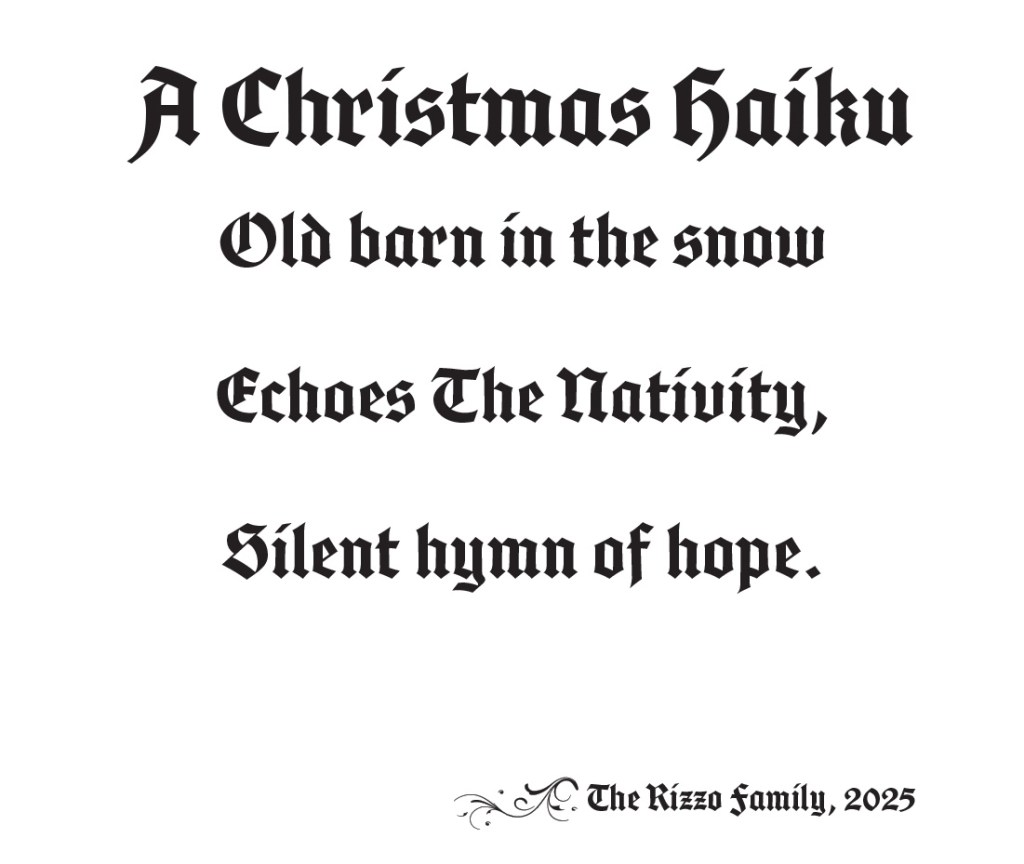
Poem: Old Barn: A Christmas Haiku, 2025, Stephen W. B. Rizzo

Rizzo's Rambles and Ruminations
on culture, politics, education, religion, family, and a host of other topics
Blogs in this category are general in nature.
Photo: Uncle Frank’s Barn in the Snow, 2025, Stephen W. B. Rizzo
Poem: Old Barn: A Christmas Haiku, 2025, Stephen W. B. Rizzo
I will be making mistakes today, just as I did yesterday and the day before. Of course, I will not know it in the moment. Only time will tell. Sometimes time is short, like after sticking your tongue to a flagpole in winter. Sometimes it is longer, much longer, half a lifetime longer, when you discover someone you thought to be a trusted friend proves otherwise. Most are somewhere in between.
So as I go about this day’s mistakes, I’ll look back on my past and try to learn from missteps and bad choices. But the one thing I won’t do is let the past teach me to shy away from taking chances and moving forward with my life with the absolute confidence that I will make mistakes because the absolute worse mistake I could make is to do nothing for fear of failure.
No, a catastrophic situation did not prompt this proclamation, and nothing dramatic is happening in my life… yet. But who knows what today’s decisions might yield!
First, let me begin by saying that even though I teach English, I do not judge people based on their speech. (I didn’t say I don’t judge; I just do not judge based on speech.) I honestly love to hear the different dialects of English, which can vary widely even within a small region. I make a point to tell my students that when they go home, they are not to correct their grandmothers. For putting up with them, Grandma (Granny, Nona, Yaya or whatever she goes by) has earned the right to say what she thinks however she wishes to say it. In fact, I sometimes use incorrect grammar depending on the context simply because it would sound odd and out of place to do otherwise. In other words, there is grocery store English, the English you use at Winn Dixie or Piggly Wiggly (yes, for those “not from around here,” those are real stores), and then there is job application English, or what we in the business call Formal Standard or Edited English.
And speaking of editing, one of the things I most often find in student papers is a complete and utter lack of understanding of comma use. I do not really know why since commas, just like periods, have rules about when and where they are placed. Yet, students (and my buddy Roger) struggle with commas.
I said I do not know why, but I think I actually do. Students simply do not learn the rules, or at least they do not learn all of them. Instead, they substitute their own willy-nilly rules. So here is my little diatribe about the three NOT comma rules that I have discovered students most often employ.
The emotional comma rule:
Student: “I put a comma there because I felt like it needed one.”
Emotions are generally NOT what you want to use to make any decision. Think about the times in your life when you let your emotions decide for you. Yeah, there you go. So do not place a comma somewhere just because you feel like one is needed.
The artistic comma rule:
Student: “It just looks like it needs a comma there.”
Sorry, but your aesthetic choice for placement of commas is as flawed as the emotional commas. Looks, as the saying goes, can be deceiving. You cannot decide comma placement by looks.
The respiratory comma:
Student: “I put a comma there because I paused and took a breath.”
While this looks like a rule and is related to a reading guideline, this is not how you place commas. Somewhere in your early academic journey, maybe second or third grade, your teacher was helping you learn how to read. Along the way, he or she began to coach you on how to read with feeling and cautioned you to slow down or pause at a comma. But just because you pause at a comma when reading is not the reason it was placed there.
Let me draw an analogy for you. When you drive, you stop at stop signs (or at least you better). But, when you stop do you get out of your car and plant a stop sign in the parking lot, your driveway, etc.? Of course not. In the same way, while you might pause at a comma when reading, you do not put one where you pause when reading what you are writing. You might pause at a different spot than I would because your natural speech pattern is different than mine or maybe because I just climbed a flight of stairs.
Beware of these three rules that are not really rules. Just like periods, commas have rules for their placement. After all, hardly anyone above the first or second grade just places a period where he or she feels like it. They use rules to place periods at the end of a sentence or with an abbreviation.
Just as periods show an end, in English commas generally separate or set off things. Depending on how you slice them, there are about ten comma rules, including using a comma to separate items in a series, using a comma to set off a noun of direct address, using a comma after an introductory element to separate it from the main clause, using commas to separate parts of an addresses or dates.
If you are interested in learning or at least looking at a list of comma rules, since I’m not going to list all of them, here is a source I direct my students to for all kinds of English grammar and writing help: https://owl.purdue.edu/ No, I do not get a royalty for sending you here. I am just doing my part to help you develop some “comma sense.” (Now that’s puny.)
Happy editing!
P.S. There’s a comma usage error in the blog. Did you catch it?
The impetus for this little flash of inspiration (at least I hope it is inspired) was a recent conversation with a friend and ministry colleague, but as Emerson wrote to Whitman, it also “had a long foreground” in my life’s experiences and in the distillation of ideas by many others. In mulling over what is to follow, I initially thought to title this piece leadership something or other. Truth be told, however, leadership positions are rare and not easily attained. But influence is something that we can develop regardless of our station or role. My proposition, then, is not how to lead but how to live a life of influence, which comes down to one, two, three… six.
ONE LIFE
There is only one of you. You have desires and dreams, and you have abilities and influence, maybe even amazing dreams and significant influence. Still, what you can do alone is limited. On the other hand, through healthy, meaningful, intentional relationships, what you can accomplish in conjunction with others is exponential.
Up front, I need to state an axiom. Two relationships, your relationship with God and your relationship with your family, must supersede the following. If they do, these relationships will invigorate and nourish what follows. If they do not, failure in one or both of these primary relationships will diminish and taint success in any other area of life.
We all have areas of interest and influence, whether you are the gardener or the president. (You might be surprised at which one has the greater sphere of influence. If you do not believe this, study the life of George Washington Carver.) Of course, there are exceptions to every rule. But I surmise the majority of us at most can successfully operate in only a very limited number of areas.
TWO SPHERES OF INFLUENCE
Consequently, I recommend that you select two spheres of influence, just two. These are areas where you have a passion, standing, and opportunity. These could be large and expansive or small and focused. Regardless, they must be realistic for where you are in your life.
There is a good chance you will discover that your two areas of interest are related but not synonymous per se. They might or might not be scalable over time. Likely one will be more important to you than the other. Do not be rigid, yet the more clearly you can enunciate your spheres the more you free yourself of the noise and clutter in your life.
This does not mean you do not have other areas of your life or concerns where you are tangentially or temporarily engaged. But these two areas will frame and focus who you are, where you primarily engage, and how much of your resources, the most precious of which is time, you allocate.
THREE GOALS
Develop up to three goals, no more, for each area. A goal must be concrete and measurable. While you might personally benefit from accomplishments in these areas, ultimately the more altruistic your motivation and goal, the greater your sense of accomplishment and fulfillment will be. (There is nothing wrong with having a feeling or sense of accomplishment and probably something wrong if you do not.)
Your goals are not set in stone. Some goals might be finite and, therefore, could be accomplished at some point. Your priorities could shift for any number of reasons, such as you gain more insight in an area or life in general. Spheres of influence could change, or your own life situation changes. Still, some goals might be perpetual and lifelong.
SIX PEOPLE
Finally, for each area select six people whom you are prepared to invest your life in to accomplish your goals. These can be mentors, mentees, or partners. (Sometimes the lines between these roles will blur.) You could discover there is overlap in the six in your spheres of influence, and you might never have six all at one time. Certainly, I do not mean find people to use to get what you want. Rather, these are relationships that you will cultivate and invest in over time. These are relationships that are mutually beneficial and nourishing. Outside of your relationships with God and your family, these people you select and relationships you develop will form and frame you over the course of your life more than you might imagine, so choose wisely.
Why six? Several reasons, but I will mention one. If you select six individuals in two spheres of influence, you have selected twelve people you value enough to invite into your life. If twelve was enough for Jesus, then it should be more than enough for you.
Mentors, partners, and mentees will come and go in your life for a myriad of reasons. Pastor Roger Daniel contacted me when he needed a six-month interim music pastor. Since then, a meaningful twenty-year friendship has followed. On the other hand, not too long ago I lost a dear friend through death. Only my father’s passing has left a bigger hole in my life than the loss of Randy Beck. Others come and go because of a change in vocation or location. Sometimes your priorities diverge. And sadly, some may leave you through betrayal or apostasy. When this happens, do not be surprised. After all, Jesus had Judas.
When you are young, if you are smart you will find mentors, people who are wiser, stronger, more developed, and better connected in your areas of interest. As you mature and develop, you should continue to have mentors, but you will also begin to make partners, men and women with like passions and complementary gifts and abilities. Of course, at some point you should find yourself in the role of mentor as well if you grow better, not just older. But what you should never do is find yourself alone. Stay engaged with people – your people.
To recap, put God, not ministry, first and family second in your life will align your overall priorities.
Limit yourself to two areas of significant interest or influence will guide you in allocating your resources.
Have clear and measurable goals will focus and direct your actions.
Engage a set of people with whom you intentionally engage will drive your calendar and multiply your effort.
Of course, none of this is a guarantee of success, but it will ensure a greater likelihood of success with reduced stress and decreased anxiety, byproducts of prioritizing and focusing the one life you have.
In the beginning –
Light spread across the cosmos at His Word.
Lightnings flashed from Mount Sinai at His presence.
In Bethlehem –
A child born – Eternal Light wrapped in flesh and swaddled –
His mother’s eyes twinkled at His smile.
A Son given – Eternal Light embraced by mortality and death –
Hell stared in terror before His consuming flame.
In the land of shadows –
The people who stumbled in darkness rejoiced
As the great Light shone.
The nutcracker (photographed 2022) on this year’s card is part of Cullman’s Christkindlmarkt. This is one of the twin nutcrackers, approximately fifteen feet tall, that flank the gateway to the Christkindlmarkt.
The card design is by my son, Nicholas S. M. Rizzo. The season’s greeting is in German. The font is based on Bauhaus (Germany, 1919-1933) principles. His overall design is straightforward with an emphasis on negative space.
Christmas Memories
I have a vivid memory of riding down Highway 78 with my grandfather in his 64 Impala listening to Christmas carols to the illumination of the emerald green dashboard light.
I remember racing Evil Knievel action figures down the stairs with my cousins at my aunt’s and my uncle giving us all silver dollars in Christmas cards.
I remember as a child gathering on Christmas with my great-grandmother’s family and as a dad spending Christmas at the Chattanooga Choo Choo with my kids.
I well recall shinning silver tinsel trees, electric candles in the windows, Santa pictures at Pizitz, paper chain link garlands, nativity displays, mistletoe, wassail, fruitcake cookies, baklava, and after the Church Christmas pageant brown paper bags filled with oranges, apples, and nuts.
This year from my family to yours, may you make Christmas memories to cherish for years to come!
The accompanying photo titled Weihnachtspyramide, 2022, was taken in Cullman, Alabama, of the largest Christmas pyramid in the United States.
“Christmas Gifts”
Silver bells ringing, chestnuts roasting, reindeer prancing
Sleigh bells jingling, lords a-leaping, sugar plums dancingA one horse open sleigh to ride; Church bells to play their old familiar carols
A Red Ryder to shoot your eye out; Pa rum pum pum pum a drum to tap
A whistle and a ball and a whip that cracksAngels we have heard on high
And a crutch in the corner with no ownerTannenbaum, holly, mistletoe
Fruitcake, nutcracker, snowman
One spear, three spikes, five wounds
(The accompanying photo titled An Old Fashion Christmas was taken in U.G.White Hardware in Athens, Alabama.)
Over the last year, I’ve dusted off my trumpet. (Actually, I bought a new one. Thanks, Pastor Roger Daniel, for letting me try yours and, Scott Berry, for letting me buy one of yours.) And I’ve dusted off my composition and arranging skills, or at least I’m trying to. This arrangement of “Crown Him With Many Crowns” and “A Mighty Fortress is Our God” is a product of that. For the time being, this computer generated version will have to suffice until I can get a “real” recording made. (Pat Bowden and Cheryl Crauswell, thanks for the feedback on the piano accompaniment.)
I love hymns! I love to sing them and to play them. Unfortunately, the church tradition I grew up in used what is traditionally called gospel or convention or camp meeting songs but precious few traditional hymns. I was introduced to the vast corpus of traditional hymns of the Church in high school by two people. One was my high school choir director Marla Wilson. (I was introduced to the quadratic equation and pressure on the trapezius muscles by her husband Jerald, which is a story for another day.) The other was my band director and now long-time friend Allen Bailey.
My senior year in high school, I was in Teen Talent, a talent competition hosted by the Church of God (Cleveland) to foster participation in the arts as a means of worship and ministry. Allen arranged “Savior Like a Shepherd Lead Us” and “The Church’s One Foundation” for trumpet and piano and accompanied me. I fared well in the various levels of competition, but the real win was in getting to know these hymns that remain two of my favorites.
Not to make this a music class, but hymns for the last few centuries tend to be strophic, syllabic, and homophonic. This is a generalization. Different church traditions adhere to or diverge from it. Of course, the primary purpose of hymns is praise and worship of God. I recall Dr. David Horton’s (Lee University) discussion of traditional hymns, how they extoll or proclaim the attributes of God or make affirmations of faith. Generally speaking, they tend toward a more corporate than individual expression of worship. Also, they are chock full of theology, much more so and much more sound than gospel songs or contemporary worship choruses. In fact, Dr. Timothy George of Samford’s Divinity School recalls his days of seminary and how various professors would parse the lines of the hymns and joined in or refrained from singing certain verses because of their theological content. I fear today we too often glibly sing along to contemporary church music because of the catchy rhyme or repetitive hook but give no thought to the Biblical validity – or lack thereof – of the lyrics. But hymns provide the depth of Biblical truth set to tune.
Finally, some of those tunes and verses stretch back hundreds and hundreds of years. The melody of “O Sacred Head Now Wounded” dates back to the early Baroque. (Today, most are probably familiar with Bach’s chorale setting of the melody, but Hans Leo Hassler is actually responsible for the melody that is used for German and English settings of the hymn.) The lyrics date back to a Latin hymn Salve mundi salutare from the Middle Ages that speaks of the physical sufferings of Christ during the crucifixion. Therefore, when we sing this hymn we are singing a melody from 500 years ago during the heart of the Protestant Reformation with lyrics from the Middle Ages during a time of suffering and uncertainty when some fifty percent of Europe died from the Black Plague. Yet, this is more than an exercise in history. It is a recognition that the same pepituary death of Jesus 2000 years ago unites us as His Body, across time, geography, language, and culture.
I still respond to the camp meeting songs I grew up with and see validity in worship choruses, both of which are a more personal expression of praise. But if these are the appetizer and dessert, the hymns are the main course, musically and theologically. If you participate in a worship tradition that uses hymns, don’t sing them dispassionately but do so with fervor and listen to the lessons of the faith contained in their lines. If you do not use hymns in your worship, may I invite you to consider adding them and join with your brothers and sisters in Christ who have sung hymns for hundreds of years to declare His majesty and love.
Last week we had a diversity event on my college’s campus, and I was asked to prepare a booth on Italian-Americans. Since October is Italian-American Heritage Month, I thought I would share some of it as a blog as well. (Oh, and I’ve included a tarantella to put you in the right mood while you read.)
There’s a litney of contributions by Italian-Americans I could have shared and a long list of names, nationally and locally, all of whom deserve recognition. But instead, I opted for something more basic, something we share, something that reflects us as a group – good, hearty, and comforting food.
As with other immigrants, when Italians came to America most were leaving behind a difficult life in hopes of a better future. The bulk of Italians who made the Atlantic crossing were mezzogiorni or Southern Italians, which reflected the historic reality that Southern Italy was significantly less prosperous than Northern. While in Italy, they lived and made the most of what they had. An example of this is the cultivation of cucuzza, an edible gourd that can grow up to five feet in length.
The plant requires little space when trellised and is a prolific producer.
Southern Italians made the most of the plant, consuming both the gourd and its tender shoots and leaves.

Tenerumi is made from the (deveined) leaves and tender shoots sautéed with garlic. Cucuzza can also be incorporated into soups and stews, stuffed, breaded and fried as a stand-alone dish or incorporated in cucuzza parmigiana, or served raw in salads.
As they immigrated, Italians brought the seeds with them. Today, it’s not uncommon to find cucuzza in the gardens of Italian-Americans across the country.
If you are fortunate enough to have an Italian-American neighbor who grows cucuzza, ask for one. Trust me, they will have extras. Like I said, these plants produce. If you’re not as fortunate, then you can probably find cucuzza in a market that specializes in Mediterranean food or sometimes in Asian markets as well.)
Ingredients
One large cucuzza (3 or 4 feet long)
A large bunch of carrots peeled and chopped or large bag of baby carrots.
Three or four garlic cloves chopped
Two large (28 ounces) cans of petite diced tomatoes
(Fresh tomatoes are better if they are homegrown. But don’t use the tasteless ones you get from most groceries.)
Optional – one large can of tomato puree
Oregano, salt, and pepper
You can also add celery, potatoes, etc., pretty much veggie that strikes your fancy, of course. Adding stew meat is also an option.
Directions
Peel the Cucuzza. Slice it down the middle longways. Clean out the soft interior with seeds. I usually use a spoon to scoop this out. Then cut the cucuzza into roughly half inch cubes.
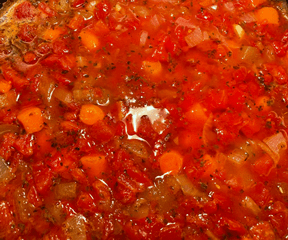
In a ten quart soup pot or crockpot, combine cucuzza, carrots, diced tomatoes, and garlic.
Add dried or fresh chopped oregano, salt, and black pepper to tastes. (I really like oregano, so I tend to add a little extra.) Add two to four cups of water as needed water.
You will probably need to cut the acid of the tomatoes. For this batch, I used about a tablespoon of sugar. Don’t worry, it does not make it taste sweet. It just balances the acid. There are other options as well. Mr. Maltese, one of my music instructors from my undergraduate years added raisins to his sauces. I do this for sauces, but tend not to do it for soups and stews. Another trick that I have used is adding a whole, peeled Russet potato, which you remove before serving. Baking soda also could be used.
Bring to a boil and then reduce the heat and simmer until the vegetables are tender. I usually like to let it set overnight to allow, as a friend says, the flavors to marry.
Buon Appetito!
And when we have all known the bitter bite of cold
The pain of separation
The longing remembrance of loss
The horror of alienation,
Then may we learn the warmth of the love of Christ
That reunites, restores, and reconciles
Through manger, cross, and empty tomb.
Over the last couple of years, I’ve been fortunate to engage in several arts events sponsored by the Walker County Arts Alliance, which has given me the inspiration and opportunity to explore my interest in photography. During that same period, my kids have gotten licenses and now chauffeur themselves around, which has given me a tad more time to pursue my photographic endeavors. Oh, and last but not least, my mentor Alice Wilson has given me ample direction and feedback to help me improve. I’m not there yet, but I’m getting better and having fun doing it. Of course, all of that rambling preamble is simply to say that for my Christmas card this year I got creative and used some of my own work.
The photo accompanying the blog, titled Winter Woods (2009), is one I made several years ago and used this year for the cover of my Christmas card, and the Christmas Meditation is one I included in the card.
No, I’m not about to start creating cards for Hallmark. In fact, I really hope my words reflect the opposite of the too sweet sentiment of Hallmark fare. The photo was for fun. But the meditation is about something more important.
The love of Christ is not a warm fuzzy that rolls around at Christmas and vanishes by New Year. When we truly encounter His love, we will not remain the person we were. To learn of the love of Christ is not just to hear of it, but to be changed by it. We will not do the selfish and self-destructive things we did. Instead, we will live out the new life he gives.
My prayer this Christmas is that you learn of the love of Christ and allow Him to change you from who you were to a new person in Him.







 Rizzo's Rambles and Ruminations