
This morning, I was in the drive through at McDonald’s picking up a breakfast order that cost $19.78. Normally on Sundays, I eat breakfast at my church in the café between choir and band rehearsal and the morning worship service. The proceeds from the church café support our church outreach ministries, so it is a good way to support my church and not have to make breakfast early before I leave home. But this morning, we were not having choir and full band because the church facilities were already decorated for our upcoming Vacation Bible School. We have new children’s pastors, Jeremiah and Averill Johnson. They are already doing a great job. The decorations, something like a wilderness campsite, were amazing when I arrived for band rehearsal.
That’s right, I showed up for band rehearsal even though we were not having it! Why? Because our music pastor didn’t remind me! Nah, just kidding. He had mentioned it in a previous rehearsal and had sent a text reminder to the full music department. I had just not paid attention. That did not keep him from feeling bad and apologizing for not sending out an additional reminder. But it was entirely on me. Blaine Johnson, our music pastor, is a Nashville-based musician, but he is also one of our homegrown musicians who returned to us about a year ago to serve as our music pastor. He has a servant’s heart and truly felt bad about the morning mix up, even though it was my fault. (Two more quick things about Blaine. One, he is focusing a lot of attention on the horns and writing charts that are solid and idiomatic to the wind instruments. Yeah! Two, he took me backstage to meet Allison Krause, something for which I am eternally in his debt. Sigh.)
Anyway, since I was going to have extra time on my hands this morning, I decided to pick up breakfast early and run it back to the house where my kids – actually, the other adults who live at my house – were still getting ready. I prefer McDonald’s because I like its potato cakes, and since I was ordering breakfast, it did not matter if the ice cream machine was broken.
When the server said, “That will be 1978,” I quipped, “That was a very good year.” Yeah, I’m clever like that. My kids – the adults who live at my house – call that a dad joke.
The server responded, “I’ll bet things were cheaper then.”
My response, “Yeah, plus I was still in high school, living in my dad’s house.”
At that, he smiled, and I pulled to the next window to get my order.
As I did, I began to travel down what Robin Williams in Dead Poet’s Society calls “Amnesia Lane,” reflecting on 1978. As I pondered, I realized it was, indeed, a good year and one with more significance than my glib retort to the drive through server conveyed. What follows is my musings from this morning about the year 1978, the fruit of what Wordsworth calls the “spontaneous overflow of powerful feelings… recollected in tranquility” as I ate my sausage, egg and cheese biscuit and sipped my half and half tea.
1978 Anno Domini was the end of my sophomore year and the beginning of my junior year at Mortimer Jordan High School in Morris, Alabama. In January of that year, my family lived in unincorporated Jefferson County in a community called Masseyline where my father pastored a church where he preached and I played trumpet every Sunday morning and Sunday evening. If I remember correctly, it was around this time, likely in January, my birth month, when my dad purchased me a new trumpet. We went to 2nd Avenue, North, in Birmingham to Nuncie’s Music. The owner, Mr. LaBerte, waited on us himself. Nunzio “Nuncie” LaBerte founded the music store in 1946. Though he was our sales representative that morning, later Joe Hull would be the customer rep whom I would deal with while I was in high school, through college, and even decades later when my own children started band. Joe told me stories about Mr. LaBerte running out of the store office telling the sales reps not to extend more credit to the group Alabama. Of course, that was before Alabama became an overnight success after twenty years on the road. Anyway, that day in 1978, Mr. LaBerte did extend credit to us. Of course, he also charged us full sticker price.
Since then, I have learned to wheel and deal and purchase used horns. I now have around seventeen brass instruments (I lose track of exactly how many). But on that day in 1978, price did not matter. First, because my dad was paying for it. Second, and maybe even more importantly, because the horn was beautiful. It was a Vincent Bach Bb Stradivarius, ML 37, lacquer trumpet. When I opened the case, it had that new trumpet smell, which is something akin to a new car smell but infinitely more glorious. And the sound of the instrument was that characteristic dark tone that Bach’s from that era are known for. My dad, a non-musician, commented that even he could tell a difference in the sound between my Old’s beginner trumpet and the Bach. I still have the horn. For something like 40 years, it was my go-to instrument, and I played it indoors and outdoors all over the country with numerous college and church ensembles and not a few paying gigs. Though the finish is now more tarnish than lacquer and it sports a repair on the second valve slide by my college band director, Dr. David Walters, it is still an outstanding sounding horn and serves as a respectable backup to my new Yamaha Bergeron Model that I procured at a sweet price in 2020 from a dear friend, Scott Berry. (Sadly, Scott passed just a few years later.)
In the spring term of 1978, Phillip Renda was my band director at Mortimer Jordan. Renda, not Mr. Renda, just Renda, as we affectionally called him, was a also a trumpet player and a Jacksonville State University graduate and was one of the primary reasons that I decided to audition for the Marching Southerners and major in music at JSU and when I graduated. He was a riot to be around, and I spent countless happy hours in the band room, on the practice field, and in the stands at football games under his direction, as well as private time talking with him and a small cadre of students in his office. I remember snippets from then. For example, we played “Kentucky 1800” in concert band. I recall he once asked his office entourage if we knew what pizz on a music score meant. I did. (Incidentally, it means to pluck with the fingers instead of bow the strings, for example, on a violin.)
Renda fostered my interest in music in a number of ways beyond the classroom. In 1978, along with a handful of other Marching Blue Devil band faithful, I attended a Chuck Mangione concert with Renda and his college buddy, Mike Jones. I still recall the concert. Mangione was in rare form. “Feels So Good” had been released on his album by the same name in 1977 and the single in 1978 and would ultimately reach number four on the Billboard Hot 100, no mean feat for a jazz (sort of) instrumental piece. I also remember that when we got to the concert hall in Birmingham, Renda and Mr. Jones could not find their tickets and had to buy more. (Weeks later, we found the tickets in his center desk drawer, though I am not sure he ever confessed this to Mr. Jones.) Seeing my interest in music, he loaned me his copy of Donald Jay Grout’s A History of Western Music, which was still the standard music history text when I started JSU two years later. I returned it to him, slightly worse for the wear thanks to our toy fox terrier, before he left Jordan in May or June of 1978. That’s right, he left Jordan in 1978.

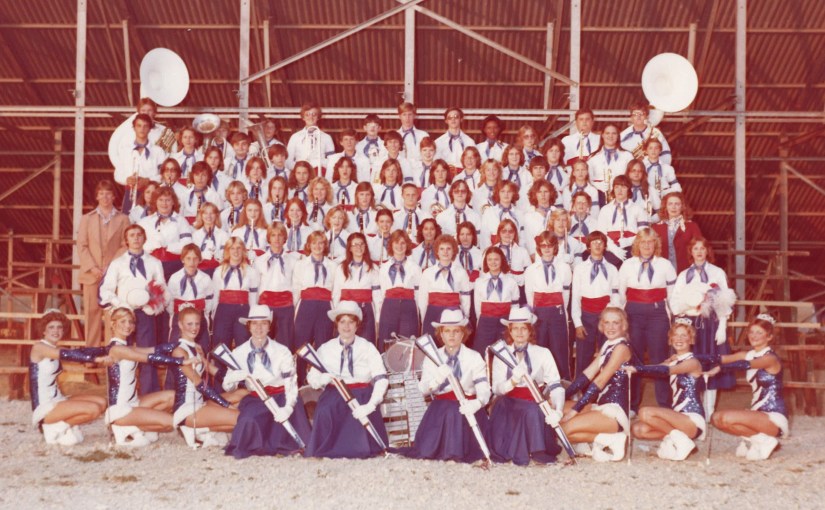
My last memory of Renda at Jordan is standing in the band room with him and Mr. Trotter, the principal, as Renda named Tony Cousins band field captain and Vickie Nail and me co-drum majors. Tony was a drummer and one of the nicest and most popular guys in the band. We still see each other… at least on Facebook, and a few years ago I had the pleasure of teaching his daughter at my college. As for Vickie, she was the youngest of the Nail sisters, who were three of the prettiest girls ever to grace the halls of Mortimer Jordan. We had matching uniforms, except hers had a long skirt. Our shirts were bright white and silky (probably Rayon, something I had to Google) with matching blue neck kerchiefs, red cummerbunds, and Cavalier hats with long ostrich feathers dyed blue and red. My shirt, a bit faded from time, hangs in the back of my closet; the hat rests on a bust atop the bookshelf in my bedroom; and the cummerbund and kerchief are long lost – 1978 was some time ago, after all. As with Tony, my contacts with Vickie now are pleasant but mostly over Facebook.
I am also still in contact with Renda. We periodically message each other, and I love reading his Facebook posts about his Sicilian roots, something we share, his tributes to his mom and dad and his faith. He has retired from band directing… and come out of retirement more than once and continues to foster a love of music in his students. (He also passed the passion to his son, Stan, who is an outstanding director in his own right.) And Renda and I get to eat, reminisce, and play together at the Jacksonville State Southerners Alumni Reunion, and hopefully will do so again this coming November.
Back to 1978, after the school year ended my dad made a decision that is a testament to the type of man and father he was. It was time for him to change pastorates. He had two options: take a promotion that moved my family from the area and me away from Mortimer Jordan or accept a smaller church appoint that kept us in area and me in the same school district in order for me to be drum major. All I have to say is that summer I met my new band director… at Mortimer Jordan! (Thank you, Papa Bear.)
In the summer of 1978, Allen Bailey, also a JSU graduate, took the position of band director at Mortimer Jordan. Renda may have started the spark but Allen truly fanned the flame of my interest in music as a career. (Wow, that sounds cheesy, but it is true.) I do not remember all of the music from the fall of ’78, but I do recall we played Allen’s arrangement of Jenkins’ “American Overture for Band.” It was a great piece. But Allen did not just expose me to great music but to great performances. I rode him along with his then fiancé and now wife, Debbie, to Troy University to see the Marching Southerners. Of course, weather delayed us ; consequently, we only got there in time to see them march off the field after the halftime show. He also took me and another band friend with him and Debbie to a drum and bugle competition at Jacksonville State. That trip his car died in Anniston on the way home, so waiting for a garage to open the next day, we four spent a restless night at The Heart of Anniston Hotel. We paid the nightly, not hourly rate (enough said). Then when I was in the Southerners, he and Debbie ferried me to Birmingham to march in the Veteran’s Day Parade. That time a policeman stopped us as Allen pulled onto the Interstate. Come to think of it, traveling with Allen was frequently interesting.
After Vickie graduated, leaving me the lone drum major, Allen arranged for lessons with Gordon McGraw, the drum major at Jacksonville State. Once a week for I’m not sure how long, I hopped in Allen’s car, and we headed to Jacksonville. Fortunately, we did not get caught in a deluge, break down, or get stopped by the police. Gordon and his roommate, Tam Easterwood, were hilarious, and I benefitted greatly from the lessons. First-place competition medals packed away somewhere testify to this. And I have a couple of trophies, as well, thanks to Allen. He arranged solos for trumpet and accompanied me on the piano when I competed in Teen Talent, a talent competition sponsored by my denomination, when I competed at regional, state, and nationals. He also played for me when I auditioned for a music scholarship at JSU, though I did not get a scholarship. But that is OK. At the audition, he introduced me to Dr. Walters and Dr. Davis, two men who would also have a significant influence on my life.
Oh, there is one more trip I should mention. After the national Teen Talent competition in Dallas, Allen and I flew back to Alabama together. I stayed with him and Debbie for a few days. We raided my mom’s kitchen for any pot, pan, or ladle I wanted (something she still talks about); then he and Debbie moved me to Jacksonville in time for Southerner’s band camp, all because of 1978.
By the way, I call them Allen and Debbie instead of Mr. and Ms. Bailey because we became friends. I was honored to be Allen’s best man in their wedding. For years, he was the pianist at my dad’s church in Gardendale. For my parents, he was just another one their kids and was welcomed in their home like one. Symbolic of this relationship, Allen wore a tie my dad had given him to my dad’s viewing after he passed. He pointed this out as he hugged my mother. Finally, a few years back in a Facebook post, I complimented a former student on her success, saying how proud I was of her. Allen responded to my post and said that my expression of pride in my student was exactly the way he felt about me. Yeah, that was a lump in my throat moment. I am embarrassed to say that I do not contact Allen as much as I should, something that I thought about just a few days ago. It is time I did something about that.
I realize what began as a brief muse has turned into a long ramble. I do not apologize, but I will close. My memories of 1978, its seminal events and other special people, such as Noah White, Sarah Glover, Devin Stephenson, and Jerald and Marla Wilson, to name a few, continued to fill my thoughts Sunday. It is interesting what can trigger a flood of memories – the smell of freshly cut grass, the sound of a marching band, the glimpse of an old photograph on the mantle, or even the cost of breakfast at McDonald’s. We cannot live in the past, but visiting it is not a bad idea, especially when it spurs us to reach out in the present to the people who made the past special.
Gotta go, I have some folks to get back in touch with.


 Rizzo's Rambles and Ruminations