

Photo: Uncle Frank’s Barn in the Snow, 2025, Stephen W. B. Rizzo
Poem: Old Barn: A Christmas Haiku, 2025, Stephen W. B. Rizzo

Rizzo's Rambles and Ruminations
on culture, politics, education, religion, family, and a host of other topics
Photo: Uncle Frank’s Barn in the Snow, 2025, Stephen W. B. Rizzo
Poem: Old Barn: A Christmas Haiku, 2025, Stephen W. B. Rizzo
First, let me begin by saying that even though I teach English, I do not judge people based on their speech. (I didn’t say I don’t judge; I just do not judge based on speech.) I honestly love to hear the different dialects of English, which can vary widely even within a small region. I make a point to tell my students that when they go home, they are not to correct their grandmothers. For putting up with them, Grandma (Granny, Nona, Yaya or whatever she goes by) has earned the right to say what she thinks however she wishes to say it. In fact, I sometimes use incorrect grammar depending on the context simply because it would sound odd and out of place to do otherwise. In other words, there is grocery store English, the English you use at Winn Dixie or Piggly Wiggly (yes, for those “not from around here,” those are real stores), and then there is job application English, or what we in the business call Formal Standard or Edited English.
And speaking of editing, one of the things I most often find in student papers is a complete and utter lack of understanding of comma use. I do not really know why since commas, just like periods, have rules about when and where they are placed. Yet, students (and my buddy Roger) struggle with commas.
I said I do not know why, but I think I actually do. Students simply do not learn the rules, or at least they do not learn all of them. Instead, they substitute their own willy-nilly rules. So here is my little diatribe about the three NOT comma rules that I have discovered students most often employ.
The emotional comma rule:
Student: “I put a comma there because I felt like it needed one.”
Emotions are generally NOT what you want to use to make any decision. Think about the times in your life when you let your emotions decide for you. Yeah, there you go. So do not place a comma somewhere just because you feel like one is needed.
The artistic comma rule:
Student: “It just looks like it needs a comma there.”
Sorry, but your aesthetic choice for placement of commas is as flawed as the emotional commas. Looks, as the saying goes, can be deceiving. You cannot decide comma placement by looks.
The respiratory comma:
Student: “I put a comma there because I paused and took a breath.”
While this looks like a rule and is related to a reading guideline, this is not how you place commas. Somewhere in your early academic journey, maybe second or third grade, your teacher was helping you learn how to read. Along the way, he or she began to coach you on how to read with feeling and cautioned you to slow down or pause at a comma. But just because you pause at a comma when reading is not the reason it was placed there.
Let me draw an analogy for you. When you drive, you stop at stop signs (or at least you better). But, when you stop do you get out of your car and plant a stop sign in the parking lot, your driveway, etc.? Of course not. In the same way, while you might pause at a comma when reading, you do not put one where you pause when reading what you are writing. You might pause at a different spot than I would because your natural speech pattern is different than mine or maybe because I just climbed a flight of stairs.
Beware of these three rules that are not really rules. Just like periods, commas have rules for their placement. After all, hardly anyone above the first or second grade just places a period where he or she feels like it. They use rules to place periods at the end of a sentence or with an abbreviation.
Just as periods show an end, in English commas generally separate or set off things. Depending on how you slice them, there are about ten comma rules, including using a comma to separate items in a series, using a comma to set off a noun of direct address, using a comma after an introductory element to separate it from the main clause, using commas to separate parts of an addresses or dates.
If you are interested in learning or at least looking at a list of comma rules, since I’m not going to list all of them, here is a source I direct my students to for all kinds of English grammar and writing help: https://owl.purdue.edu/ No, I do not get a royalty for sending you here. I am just doing my part to help you develop some “comma sense.” (Now that’s puny.)
Happy editing!
P.S. There’s a comma usage error in the blog. Did you catch it?
Instead of a photo and a poem this Christmas, I got creative (maybe) and opted for a calligram, a visual image and poem in one. A calligram, sometimes called a concrete poem or visual poem, is poetry in which the arrangement of words creates a visual image, in this case a Christmas tree. The poem is comprised of Christmas greetings in numerous languages. Almost all the greetings are in languages that are spoken by my friends across the globe. But just for fun, I added an Anglo-Saxon greeting in runes, though I doubt Alfred the Great is going to read my poem. And I included Latin, you know, just in case the Pope does read it.
Additionally, I decided to share an old-fashioned Christmas letter. Back in the day, Christmas letters shared the news of the year and holiday greetings. I loved getting them, especially from my cousin Diane in Houston. Of course, Christmas letters have become a thing of the past since we share each other’s lives in real time on social media. At least, I know you guys see my antics online because you tell me about it. Anyway, here we go.
My family and I have had a blessed year, and I am grateful to God for his blessings. Olivia and Nicholas both graduated from Athens State University. Olivia and Emma, her traveling pal, headed to Korea for two weeks right after graduation to spend time with two special friends, Fred and Reneea, who serve at school in Pohang. When she returned, she accepted a position with the Marion County School System as a science teacher at Brilliant High School, where she is also the band sponsor. The job keeps her busy, but she seems to be doing well.
Nick, on the other hand, only drove to Jasper after graduation where he served as the Interim Director of the Walker County Arts Alliance for several month. Additionally, he is a social media manager for Blanton Media Group, the publisher of 78 Magazine and The Walker Leader. He is learning a lot about real-world application of the skills he attained at Athens. And just to round things out, he is working on an M.A. in Visual Communications. In fact, he just got his first grades – all A’s.
The extended family is doing well also. Mom is still sharp and sassy as ever, and all things considered, doing rather well. We are all excited about the latest addition to the Rizzo clan. My nephew Chase and his wife Britney had a baby boy, Martin Joseph Rizzo, in November. He is absolutely adorable! As you can imagine, we are all beside ourselves excited about Martin’s arrival.
Finally, our congregation is blessed as well. I cannot share everything, but I will mention two additions to the church this year. Blaine Johnson joined our ministry team this year as the music pastor. He is talented, motivated, and caring. The growth in both quantity and quality of our music ministry under his direction was apparent in our Christmas service. (Find it on Facebook or Youtube at Sumiton Church of God.) And Jonah Barrett has taken on a volunteer position of Young ACollege/Young Adult Pastor. I have known him since the day he was born and am so proud of the young man he has become. His late father, Reverend DeWayne Barrett, a dear friend of mine, would be proud of his son as well. For these and all God’s blessings, I am truly grateful.
To close, over the last few Christmases I have participated in a tradition where friends and I share recipes with each other. Last year, I shared a photocopy of my grandmother’s handwritten fruitcake cookie recipe. This year, I would like to share a Greek feta cheese dip called bouyourdi.

Ingredients:
Greek feta (Get the good kind in brine water, not the crumbled, dry feta.)
Tomatoes (It is so much better with fresh heirloom tomatoes, but even canned diced tomatoes will work.)
Peppers (Traditionally a sweet bell pepper is used, but I have used all kinds depending on what I have on hand, such as pepperoncini, roasted red peppers, etc.)
Ground oregano
Olive oil
Additional toppings can include olives and thinly sliced onions.
Directions:
Place the feta in a small baking dish. Layer the tomatoes and peppers on top. Add any additional toppings you wish. Sprinkle with oregano. I love oregano, so I use a lot. If you’re new to using oregano, start out with just barely more than enough to be seen. Drizzle with olive oil. Don’t be stingy with the oil.
Bake at 350 degrees for about forty-five minutes. At about fifteen minutes in, give it a stir to mix the ingredients. (If you’re impatient like I am, you can microwave it, but it tastes better baked slowly.) Feta cheese does not become stringy like most cheeses. Instead, it has a nice creamy consistency when melted.
Pair with pita bread or chips or a nice, toasted bread of your choice. It is great as an appetizer or a snack.
When I make bouyourdi, I am reminded of a visit to my dad’s family in Galveston something over twenty years ago. We met up with dad’s cousin Mary, better known as “Wee,” and decided to go to his cousin Sonny Martini’s place for lunch, unaware that Sonny had moved his restaurant. When we arrived, we found a new restaurant and its owner, a nice Greek gentleman, instead of Sonny. But that was OK. We spent the next hour or so chatting with each other and with him, talking about Greece and family (Dad’s grandmother was Greek) and enjoying slice after slice after slice of warm feta and olives.
That was one of those times that was just perfect for making a memory. And though Dad and Wee have both passed, I go back in my mind to that day and live it over with them. My hope is that you might make similar memories and enjoy a warm plate of bouyourdi with your family and friends.
Merry Christmas!
The impetus for this little flash of inspiration (at least I hope it is inspired) was a recent conversation with a friend and ministry colleague, but as Emerson wrote to Whitman, it also “had a long foreground” in my life’s experiences and in the distillation of ideas by many others. In mulling over what is to follow, I initially thought to title this piece leadership something or other. Truth be told, however, leadership positions are rare and not easily attained. But influence is something that we can develop regardless of our station or role. My proposition, then, is not how to lead but how to live a life of influence, which comes down to one, two, three… six.
ONE LIFE
There is only one of you. You have desires and dreams, and you have abilities and influence, maybe even amazing dreams and significant influence. Still, what you can do alone is limited. On the other hand, through healthy, meaningful, intentional relationships, what you can accomplish in conjunction with others is exponential.
Up front, I need to state an axiom. Two relationships, your relationship with God and your relationship with your family, must supersede the following. If they do, these relationships will invigorate and nourish what follows. If they do not, failure in one or both of these primary relationships will diminish and taint success in any other area of life.
We all have areas of interest and influence, whether you are the gardener or the president. (You might be surprised at which one has the greater sphere of influence. If you do not believe this, study the life of George Washington Carver.) Of course, there are exceptions to every rule. But I surmise the majority of us at most can successfully operate in only a very limited number of areas.
TWO SPHERES OF INFLUENCE
Consequently, I recommend that you select two spheres of influence, just two. These are areas where you have a passion, standing, and opportunity. These could be large and expansive or small and focused. Regardless, they must be realistic for where you are in your life.
There is a good chance you will discover that your two areas of interest are related but not synonymous per se. They might or might not be scalable over time. Likely one will be more important to you than the other. Do not be rigid, yet the more clearly you can enunciate your spheres the more you free yourself of the noise and clutter in your life.
This does not mean you do not have other areas of your life or concerns where you are tangentially or temporarily engaged. But these two areas will frame and focus who you are, where you primarily engage, and how much of your resources, the most precious of which is time, you allocate.
THREE GOALS
Develop up to three goals, no more, for each area. A goal must be concrete and measurable. While you might personally benefit from accomplishments in these areas, ultimately the more altruistic your motivation and goal, the greater your sense of accomplishment and fulfillment will be. (There is nothing wrong with having a feeling or sense of accomplishment and probably something wrong if you do not.)
Your goals are not set in stone. Some goals might be finite and, therefore, could be accomplished at some point. Your priorities could shift for any number of reasons, such as you gain more insight in an area or life in general. Spheres of influence could change, or your own life situation changes. Still, some goals might be perpetual and lifelong.
SIX PEOPLE
Finally, for each area select six people whom you are prepared to invest your life in to accomplish your goals. These can be mentors, mentees, or partners. (Sometimes the lines between these roles will blur.) You could discover there is overlap in the six in your spheres of influence, and you might never have six all at one time. Certainly, I do not mean find people to use to get what you want. Rather, these are relationships that you will cultivate and invest in over time. These are relationships that are mutually beneficial and nourishing. Outside of your relationships with God and your family, these people you select and relationships you develop will form and frame you over the course of your life more than you might imagine, so choose wisely.
Why six? Several reasons, but I will mention one. If you select six individuals in two spheres of influence, you have selected twelve people you value enough to invite into your life. If twelve was enough for Jesus, then it should be more than enough for you.
Mentors, partners, and mentees will come and go in your life for a myriad of reasons. Pastor Roger Daniel contacted me when he needed a six-month interim music pastor. Since then, a meaningful twenty-year friendship has followed. On the other hand, not too long ago I lost a dear friend through death. Only my father’s passing has left a bigger hole in my life than the loss of Randy Beck. Others come and go because of a change in vocation or location. Sometimes your priorities diverge. And sadly, some may leave you through betrayal or apostasy. When this happens, do not be surprised. After all, Jesus had Judas.
When you are young, if you are smart you will find mentors, people who are wiser, stronger, more developed, and better connected in your areas of interest. As you mature and develop, you should continue to have mentors, but you will also begin to make partners, men and women with like passions and complementary gifts and abilities. Of course, at some point you should find yourself in the role of mentor as well if you grow better, not just older. But what you should never do is find yourself alone. Stay engaged with people – your people.
To recap, put God, not ministry, first and family second in your life will align your overall priorities.
Limit yourself to two areas of significant interest or influence will guide you in allocating your resources.
Have clear and measurable goals will focus and direct your actions.
Engage a set of people with whom you intentionally engage will drive your calendar and multiply your effort.
Of course, none of this is a guarantee of success, but it will ensure a greater likelihood of success with reduced stress and decreased anxiety, byproducts of prioritizing and focusing the one life you have.
My dad’s family is Greek and Italian, two cultures with coffee traditions dating back for centuries.
Greek coffee is strong. It is made in a special pot called a briki. A briki is a small copper pot. Fine ground coffee is placed in it. As the coffee boils, a foam forms at the top of the briki while the grounds settle to the bottom. Greek coffee is meant to be enjoyed slowly and savored.
Americans tend to be more familiar with Italian coffee, particularly espresso. (My daughter will be quick to correct you. “It’s espresso, not expresso!”) Espresso is also made with fine ground coffee, which is then combined with very hot water under pressure. This is what causes that characteristic hiss from an espresso machine.
But a cultural connection to coffee is not why I drink it, although it is amazing what you can find when you Google something.
My mother and grandmother drank coffee all my life. Well, actually my grandmother took a little coffee with her milk is a more accurate description.
But a family tradition is not why I drink coffee.
I drink my coffee decaffeinated and black with a spoon of local honey. (According to my doctor, the local honey can help with my allergies.) Since my coffee is decaffeinated, I do not drink it for an energy boost. Supposedly there are health benefits to coffee, but that’s not why I drink it. (I could just take the honey straight without the coffee.) And it certainly is not the taste! I cannot stand the taste of coffee.
So why do I drink coffee?
Because I am old enough.
I used to joke that I was not old enough to drink coffee. But this year I had one of those birthdays, you know, that kind that ends with a zero. So I figure maybe now I am old enough.
Zero birthdays mark milestones.
The first zero birthday marks the beginning of double digit birthdays. It is a big, round number that sets you apart from the other kids. With the second zero birthday you leave your teens and begin to move toward adulthood, at least hopefully, though in our Western culture of affluence, at twenty just as at ten most are not thinking about anything or anyone beyond the moment and themselves. They are just enjoying life. They are free with limited responsibilities, and I suppose there is nothing wrong with this.
Of course, by the time the third zero birthday rolls around, you really should not be living in your parents’ basement. You are thirty; you are grown now. Get a job! Somewhere after that second one and definitely by the third, most people are still focusing on themselves but in terms of career and family. The next several zero birthdays seem to come faster and faster and with more responsibility and change.
For example, on my last zero birthday I had just become a single parent with the custody of two young children. (This is when I probably should have started drinking caffeinated coffee because I needed the energy.) Life was busy and very uncertain. In fact, the only certainty was the knowledge that my job was to focus on raising my two children and everything else centered around that. It made differences in my career choices, my friendships and associations with others, virtually every aspect of my life was touched and re-focused on them, and it has been that way for the last decade. I am not complaining. I have said repeatedly that dad is my favorite job. But it is work. There was homework and band practice and recitals and more homework and teacher conferences and homecoming dances and more even homework and first dates and everything that goes with raising children. My involvement in my church and community was focused on helping my children engage and making those areas better for my children. Hopefully, anything I advocated for helped others as well. But the reason I showed up to the band boosters and parent teacher organization meetings was because of Nick and Olivia. Yet now, they are almost grown and on their own, having both now celebrated two zero birthdays.
So as I greeted my most recent zero birthday, it was with the realization that my kiddos were nearly grown and the compelling task of most of my existence was almost complete. Of course, I will always be their dad. You never outgrow your father, even after he is gone. But you do grow into a different relationship with your parents. I recognized my kids were almost there. And in the process, I began to wonder who I was and what was next. Yeah, I know this is a first-world problem, but it is still a problem.
I struggled through it a bit, and then I started drinking coffee because I was finally old enough. In fact, I was several zero birthdays old enough.
About this time, one of my Greek friends shared a picture of figs from a tree that his dad had brought from Greece. His dad had long since passed, but his children, grandchildren, and great-grand children were still reaping the fruits of his labor. I responded to him with a Greek proverb: “A society grows great when old men plant trees in whose shade they will never sit.” By the way, I am not old, but it helped me begin to frame my thinking about this zero birthday and beyond.
Similar to the wisdom of this proverb, there is a passage in Genesis that is often lost on those who are not from the Middle East: “Abraham planted a tamarisk tree in Beersheba, and there called on the name of the LORD, the Everlasting God” (Genesis 21:33). The tamarisk tree is sometimes called a salt cedar. It is well-adapted for inhospitable climates and can grow into a large tree that provides shade from the heat of the sun. But Abraham was not going to sit under the shade of the tree. Even the long life of a Biblical Patriarch would not be long enough for the tree to grow to full maturity to provide shade for Abraham. Instead, Abraham planted the tree trusting God’s promise that the land it was planted in would belong to his children and grandchildren and great-grandchildren and generations to come. I wonder what Abraham pondered about the fulfillment of God’s promises as he watered and tended the tree as a young sprout.
So now I drink coffee, my version of a tamarisk tree. It reminds me that between now and the next zero birthday to keep doing what I have been doing. From the outside, it probably will not look all that different. I will still work to improve my community. I will remain involved with the local school system, to the delight or dismay of the school administrators. I will continue to communicate with my elected officials. I will participate in my church, hoping to make it better, not just for me or even my kids but for generations yet to come.
Realizing my life and my work is not just about me helps me take this zero birthday in stride. I do not mean to aggrandize. After all, I am just drinking coffee, planting trees, and trusting in the promises of God.
Feel free to dance like you’ve been bitten by a spider!
Last week we had a diversity event on my college’s campus, and I was asked to prepare a booth on Italian-Americans. Since October is Italian-American Heritage Month, I thought I would share some of it as a blog as well. (Oh, and I’ve included a tarantella to put you in the right mood while you read.)
There’s a litney of contributions by Italian-Americans I could have shared and a long list of names, nationally and locally, all of whom deserve recognition. But instead, I opted for something more basic, something we share, something that reflects us as a group – good, hearty, and comforting food.
As with other immigrants, when Italians came to America most were leaving behind a difficult life in hopes of a better future. The bulk of Italians who made the Atlantic crossing were mezzogiorni or Southern Italians, which reflected the historic reality that Southern Italy was significantly less prosperous than Northern. While in Italy, they lived and made the most of what they had. An example of this is the cultivation of cucuzza, an edible gourd that can grow up to five feet in length.
The plant requires little space when trellised and is a prolific producer.
Southern Italians made the most of the plant, consuming both the gourd and its tender shoots and leaves.

Tenerumi is made from the (deveined) leaves and tender shoots sautéed with garlic. Cucuzza can also be incorporated into soups and stews, stuffed, breaded and fried as a stand-alone dish or incorporated in cucuzza parmigiana, or served raw in salads.
As they immigrated, Italians brought the seeds with them. Today, it’s not uncommon to find cucuzza in the gardens of Italian-Americans across the country.
If you are fortunate enough to have an Italian-American neighbor who grows cucuzza, ask for one. Trust me, they will have extras. Like I said, these plants produce. If you’re not as fortunate, then you can probably find cucuzza in a market that specializes in Mediterranean food or sometimes in Asian markets as well.)
Ingredients
One large cucuzza (3 or 4 feet long)
A large bunch of carrots peeled and chopped or large bag of baby carrots.
Three or four garlic cloves chopped
Two large (28 ounces) cans of petite diced tomatoes
(Fresh tomatoes are better if they are homegrown. But don’t use the tasteless ones you get from most groceries.)
Optional – one large can of tomato puree
Oregano, salt, and pepper
You can also add celery, potatoes, etc., pretty much veggie that strikes your fancy, of course. Adding stew meat is also an option.
Directions
Peel the Cucuzza. Slice it down the middle longways. Clean out the soft interior with seeds. I usually use a spoon to scoop this out. Then cut the cucuzza into roughly half inch cubes.
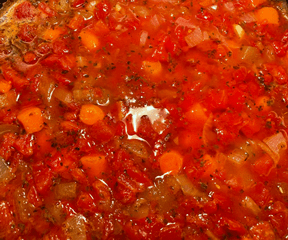
In a ten quart soup pot or crockpot, combine cucuzza, carrots, diced tomatoes, and garlic.
Add dried or fresh chopped oregano, salt, and black pepper to tastes. (I really like oregano, so I tend to add a little extra.) Add two to four cups of water as needed water.
You will probably need to cut the acid of the tomatoes. For this batch, I used about a tablespoon of sugar. Don’t worry, it does not make it taste sweet. It just balances the acid. There are other options as well. Mr. Maltese, one of my music instructors from my undergraduate years added raisins to his sauces. I do this for sauces, but tend not to do it for soups and stews. Another trick that I have used is adding a whole, peeled Russet potato, which you remove before serving. Baking soda also could be used.
Bring to a boil and then reduce the heat and simmer until the vegetables are tender. I usually like to let it set overnight to allow, as a friend says, the flavors to marry.
Buon Appetito!
Galveston, Texas, has from the time I was young has been a special place to me. My dad regularly took us to visit his father’s family in Galveston. Galveston held something of a magical, mythical place in my mind. Dad’s family came from Sicily, Italy, and Milos, Greece, in the late 1800 and early 1900s. Coming through the port of New Orleans, a port of immigration at the time second only to New York, the various families finally found their way to Galveston.
I knew about Galveston first-hand growing up spending time with my cousins, going crabbing or just playing on the beach. Oh, and there was that one time when my Maw Maw’s keys got locked in her VW Beetle on the beach in Galveston while the tide was rolling in. So, on Galveston beach I learned the importance of being able to unlock a car with a coat hanger. Of course, I loved Glenn Campbell’s hit song “Galveston” about a solider off at war dreaming of his home and love in Galveston. Like the solider in the song, “I still hear [the] sea waves crashing” in my mind.
I also know a bit about the history of Galveston and that those sea waves crash against a seawall that was constructed after the Great Strom of 1900 that decimated Galveston. In 1900, Galveston was home to many affluent citizens and was a popular up-scale vacation destination. But a hurricane made landfall on September 8, 1900. The death toll for the hurricane numbered in the thousands, but they could not be buried because the land was saturated from the flooding. Burial at sea was attempted. But the bodies floated back in on the tide. Eventually as this became a public health crisis, martial law was declared and men at gunpoint were forced to burn the decaying bodies of family, friends, and strangers. According to my dad’s cousin Benjamin Franklin Biannos, Mitchell Biannos, who was his grandfather and my dad’s great-grandfather, was among those who were required to under take this horrific task.
From Louis Ciaccio, another of my dad’s cousins, I know a more lighthearted story about the family’s “store on three corners.” It was a store run by Louis’ father Vincent with the help of my dad’s Uncle Nick, who was a young man at the time. The building that it occupied was physically moved three different times to three different locations on Galveston island. I know where my dad went to school at Stephen F. Foster Junior High in Galveston. I know where my precious Aunt Catty Mencacci lived just a few blocks from the beach. Though the last time I saw her I was young, I still remember her standing in the yard waving goodbye to us as I suppressed the urge to run back and hug her one more time. In fact, one of my few regrets in life is not running back for the one last hug.
Another though different type of regret is that as much as I romanticize, love, and know about Galveston, until a few years ago I did not know about Juneteenth, a commemoration of the end of slavery initiated by African Americans in Galveston on June 19, 1866. To be fair, a “few years ago” in my convoluted memory could be two years or two decades. But even if it is two decades ago, that is still late in life for me to learn about such a significant event, not just in the history of Galveston, but in the history of my country. I have been a history buff (OK, geek) since I was a kid. I remember much from my history classes. But I absolutely have no memory of Juneteenth being mentioned in elementary, high school, or even college.
Though it should have been recognized long before, Juneteenth is now an official American holiday, and rightfully so. It is a day that we – collectively – recall that what was wrong with America began at long last to be put right. I am not a fan of many of President Binden’s policies. But I applaud him, the Senate, and all but fourteen members of the House of Representatives for making Juneteenth a national holiday as of June 2021.
For those who do not know, here is a brief history of the date. Lincoln’s Emancipation Proclamation (https://catalog.archives.gov/id/299998), a wartime executive order, declared that effective January 1, 1863, slaves were free in the states in rebellion against the Union. The eventual military defeat of the armed forces of the Confederacy enforced this act battle by battle and mile by mile. Texas, the most remote extent of the Confederacy, was last to give way to Union advance. On June 19, 1865, Union Major General Gordon Granger arrived in Galveston and issued General Order No. 3 (https://catalog.archives.gov/id/182778372) that announced the end of slavery in accordance with the provisions of the Emancipation Proclamation.
But slavery still legally existed in a few states that had not seceded from the Union, and slavery ultimately could have been reestablished across the South. However, the ratification of Thirteenth Amendment on December 6, 1865, declared slavery at an end in America. Then, on June 19, 1866, the anniversary of Granger’s General Order No. 3, African Americans in Galveston publicly celebrated the end of slavery on what they called Jubilee Day. (The term Jubilee, of course, was taken from the Old Testament of the Bible as it was the year that Jehovah commanded the enslaved in Israel were to be set free.)
I do not care whose granddaddy owned slaves and whose granddaddy did not. The fact is slavery is America’s original sin. As a nation we were born with this deformity. The Declaration of Independence‘s lofty ideals of “life, liberty, and the pursuit of happiness” stand in stark contrast to the Constitution’s measurement of slaves as “three-fifths” of a person. This stain on the soul of our nation was excised only by the sufferings of generations of our brothers and sisters held in bondage and by the blood of hundreds of thousands in the American Civil War (as if any war could be civil). At great cost this was accomplished. Then should not we – regardless of race or creed or political inclination – exult in this together as one people.
No, we have not arrived. There is much yet that can be done. Yes, we are very divided. We are divided on what to do and how to do it. But on this date, let us as Americans all celebrate, not what has not been accomplished, but rather what has been. On June 20th, we can again debate a host of things. But today is a day of remembrance, a day of Jubilee, a day of celebrating the end of the enslavement of one group of Americans by another.
Juneteenth is an American holiday!
This is a social media post I made in January 20, 2009. With the exception of a few grammatical corrections, it is exactly the post I made at the time. This many years later, I’m sad at the division instead of unity in my country. Step back in time with me.
*******
Nothing I say below is necessarily eloquent or different from what millions of other Americans are thinking, saying, and blogging. But maybe that’s the point, we as Americans have the right and even the responsibility to speak. On this so very significant moment in American history, I feel the need to engage in this conversation.
I watched history today with my children, along with more Americans than had ever watched a Presidential inauguration in person and via all forms of mass communication. This alone was historic. Beyond that, on the platform were only the second father and son Presidents. Of course, the obvious reason so many were watching, not only was the son of an immigrant being sworn in as the 44th President, but Barak Obama was our first African-American President.
I say “our” President, yours and mine alike. He was not my candidate, but he is my President. I smiled with him as he and Justice Roberts got out of sink during the swearing in. It was poetic. I could see the excitement and restrained nervous anticipation in his face as this happened. It wasn’t perfect, but it was perfectly acceptable. It added just that touch of humanity, flawed and imperfect, amongst all of the practiced precision of the military honors afforded the outgoing and incoming administrations.
I was opposed to him during the election because of his politics, not his skin. But I, like many of his supports, must confess a sense of … well, of I’m not sure what, a mixture of emotions. Tomorrow, or maybe next week, I’ll do battle with his political ideas, I’m sure. But today, I celebrate a fuller meaning of “we the people” than ever before in America’s history.
So many commentators said it today that it may begin to sound passé, but it is true, nonetheless, only in America could we watch and celebrate today’s events, the peaceful, and in fact, gracious transfer of power of arguably the most powerful nation in history. This alone is amazing enough that it should cause us to stand in awe, let alone witness the inauguration of a man, as President Obama pointed out, whose father would not have been served at a lunch counter in the city because of the color of his skin. But today we as a people – not a race, not an ethnicity – but a people created by an idea that “all men are created equal” turned a page in our collective history.
In 1903, W. E. B. du Bois declared that “the problem of the Twentieth Century is the problem of the color-line.” Another historic thing about today is that we are facing a financial crisis that if left unchecked could rival that of the Great Depression. So, I hope that we in the Twentieth-first Century have solved, or at least greatly addressed, “the problem of the color-line” because we have many problems facing us in this century.
As I write this, Denzel Washington is announcing the President as they enter The Neighborhood Ball in Washington, D.C., tonight. I’m watching the ball with my daughter and son. I’ve discussed with them that skin doesn’t matter; rather, it’s the person’s character. Maybe their kids won’t even have to have that discussion.
As I said, tomorrow or sometime soon I’m going to have an argument with my President. But, he’s my President. He works for me now, even if I didn’t hire him. I guess it’s OK to argue. After all, it’s all in the family. But tonight I’m going to enjoy the parties and the celebrations and being an American.
There is nothing like Facebook to provide a forum for arguing with someone on the other side of the country or the world whom you will never meet in person.
My interests are varied: history, writing, music, and gardening. I’m a member of a number of Facebook discussion groups corresponding to my interests. In these groups, we have cordial and sometimes spirited discussions. But akin to those whom Stravinsky referred to as “arbiters of cultural taste,” there are some group members who believe it their job to correct the manners, politics, or in this case spelling, of absolute strangers. Normally I keep scrolling. Today my better angels did not prevail. I knew my response would be deleted by the administrator of the gardening group, as it eventually was, yet I could not resist the temptation for a tête-à-tête. (Yes, I know that technically a public post is not a tête-à-tête. But doesn’t it sound cool… and pompous.)
Let the snark begin!
The following is my sardonic critique for the group member who felt a need, in her words, to provide “this week’s lesson in English,” as she explained how to spell tomato and potato. (It’s not like Dan Quail is in the group.)
i no sum people dont no grammer as good as other’s. Butt i wood jest ruther leaf things along then other’s think im been a no it awl.
Indubitably, the essential quality and nature of the English language is ne’er strained by one’s use of dialect, non-standard spelling, grammatical faux pas, or the garden-variety typo.
I have a freaking PhD, but my great grandmother could garden circles around me. So there’s also that.
And that, gentle reader, is your life lesson for the day. You’re welcome.
Y’all come back now, ya hear.



 Rizzo's Rambles and Ruminations