$19.78 Was a Very Good Year

This morning, I was in the drive through at McDonald’s picking up a breakfast order that cost $19.78. Normally on Sundays, I eat breakfast at my church in the café between choir and band rehearsal and the morning worship service. The proceeds from the church café support our church outreach ministries, so it is a good way to support my church and not have to make breakfast early before I leave home. But this morning, we were not having choir and full band because the church facilities were already decorated for our upcoming Vacation Bible School. We have new children’s pastors, Jeremiah and Averill Johnson. They are already doing a great job. The decorations, something like a wilderness campsite, were amazing when I arrived for band rehearsal.

That’s right, I showed up for band rehearsal even though we were not having it! Why? Because our music pastor didn’t remind me! Nah, just kidding. He had mentioned it in a previous rehearsal and had sent a text reminder to the full music department. I had just not paid attention. That did not keep him from feeling bad and apologizing for not sending out an additional reminder. But it was entirely on me. Blaine Johnson, our music pastor, is a Nashville-based musician, but he is also one of our homegrown musicians who returned to us about a year ago to serve as our music pastor. He has a servant’s heart and truly felt bad about the morning mix up, even though it was my fault. (Two more quick things about Blaine. One, he is focusing a lot of attention on the horns and writing charts that are solid and idiomatic to the wind instruments. Yeah! Two, he took me backstage to meet Allison Krause, something for which I am eternally in his debt. Sigh.)

Anyway, since I was going to have extra time on my hands this morning, I decided to pick up breakfast early and run it back to the house where my  kids – actually, the other adults who live at my house – were still getting ready. I prefer McDonald’s because I like its potato cakes, and since I was ordering breakfast, it did not matter if the ice cream machine was broken. 

When the server said, “That will be 1978,” I quipped, “That was a very good year.” Yeah, I’m clever like that. My kids – the adults who live at my house – call that a dad joke.

The server responded, “I’ll bet things were cheaper then.”

My response, “Yeah, plus I was still in high school, living in my dad’s house.”

At that, he smiled, and I pulled to the next window to get my order.

As I did, I began to travel down what Robin Williams in Dead Poet’s Society calls “Amnesia Lane,” reflecting on 1978. As I pondered, I realized it was, indeed, a good year and one with more significance than my glib retort to the drive through server conveyed. What follows is my musings from this morning about the year 1978, the fruit of what Wordsworth calls the “spontaneous overflow of powerful feelings… recollected in tranquility” as I ate my sausage, egg and cheese biscuit and sipped my half and half tea.

1978 Anno Domini was the end of my sophomore year and the beginning of my junior year at Mortimer Jordan High School in Morris, Alabama. In January of that year, my family lived in unincorporated Jefferson County in a community called Masseyline where my father pastored a church where he preached and I played trumpet every Sunday morning and Sunday evening. If I remember correctly, it was around this time, likely in January, my birth month, when my dad purchased me a new trumpet. We went to 2nd Avenue, North, in Birmingham to Nuncie’s Music.  The owner, Mr. LaBerte, waited on us himself. Nunzio “Nuncie” LaBerte founded the music store in 1946. Though he was our sales representative that morning, later Joe Hull would be the customer rep whom I would deal with while I was in high school, through college, and even decades later when my own children started band. Joe told me stories about Mr. LaBerte running out of the store office telling the sales reps not to extend more credit to the group Alabama. Of course, that was before Alabama became an overnight success after twenty years on the road. Anyway, that day in 1978, Mr. LaBerte did extend credit to us. Of course, he also charged us full sticker price. 

Since then, I have learned to wheel and deal and purchase used horns. I now have around seventeen brass instruments (I lose track of exactly how many). But on that day in 1978, price did not matter. First, because my dad was paying for it. Second, and maybe even more importantly, because the horn was beautiful. It was a Vincent Bach Bb Stradivarius, ML 37, lacquer trumpet. When I opened the case, it had that new trumpet smell, which is something akin to a new car smell but infinitely more glorious. And the sound of the instrument was that characteristic dark tone that Bach’s from that era are known for. My dad, a non-musician, commented that even he could tell a difference in the sound between my Old’s beginner trumpet and the Bach. I still have the horn. For something like 40 years, it was my go-to instrument, and I played it indoors and outdoors all over the country with numerous college and church ensembles and not a few paying gigs. Though the finish is now more tarnish than lacquer and it sports a repair on the second valve slide by my college band director, Dr.  David Walters, it is still an outstanding sounding horn and serves as a respectable backup to my new Yamaha Bergeron Model that I procured at a sweet price in 2020 from a dear friend, Scott Berry. (Sadly, Scott passed just a few years later.)

In the spring term of 1978, Phillip Renda was my band director at Mortimer Jordan. Renda, not Mr. Renda, just Renda, as we affectionally called him, was a also a trumpet player and a Jacksonville State University graduate and was one of the primary reasons that I decided to audition for the Marching Southerners and major in music at JSU and when I graduated. He was a riot to be around, and I spent countless happy hours in the band room, on the practice field, and in the stands at football games under his direction, as well as private time talking with him and a small cadre of students in his office. I remember snippets from then. For example, we played “Kentucky 1800” in concert band. I recall he once asked his office entourage if we knew what pizz on a music score meant. I did. (Incidentally, it means to pluck with the fingers instead of bow the strings, for example, on a violin.)

Renda fostered my interest in music in a number of ways beyond the classroom. In 1978, along with a handful of other Marching Blue Devil band faithful, I attended a Chuck Mangione concert with Renda and his college buddy, Mike Jones. I still recall the concert. Mangione was in rare form. “Feels So Good” had been released on his album by the same name in 1977 and the single in 1978 and would ultimately reach number four on the Billboard Hot 100, no mean feat for a jazz (sort of) instrumental piece. I also remember that when we got to the concert hall in Birmingham, Renda and Mr. Jones could not find their tickets and had to buy more. (Weeks later, we found the tickets in his center desk drawer, though I am not sure he ever confessed this to Mr. Jones.)  Seeing my interest in music, he loaned me his copy of Donald Jay Grout’s A History of Western Music, which was still the standard music history text when I started JSU two years later. I returned it to him, slightly worse for the wear thanks to our toy fox terrier, before he left Jordan in May or June of 1978. That’s right, he left Jordan in 1978.

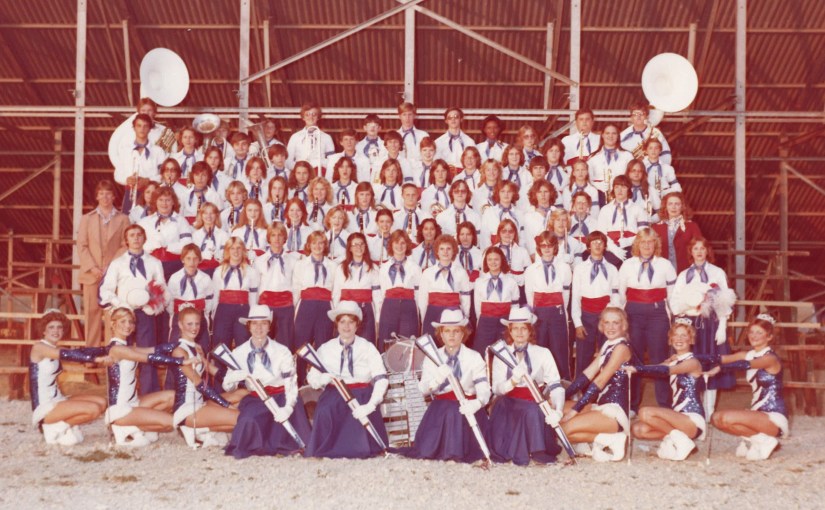
My last memory of Renda at Jordan is standing in the band room with him and Mr. Trotter, the principal, as Renda named Tony Cousins band field captain and Vickie Nail and me co-drum majors. Tony was a drummer and one of the nicest and most popular guys in the band. We still see each other… at least on Facebook, and a few years ago I had the pleasure of teaching his daughter at my college. As for Vickie, she was the youngest of the Nail sisters, who were three of the prettiest girls ever to grace the halls of Mortimer Jordan. We had matching uniforms, except hers had a long skirt. Our shirts were bright white and silky (probably Rayon, something I had to Google) with matching blue neck kerchiefs, red cummerbunds, and Cavalier hats with long ostrich feathers dyed blue and red. My shirt, a bit faded from time, hangs in the back of my closet; the hat rests on a bust atop the bookshelf in my bedroom; and the cummerbund and kerchief are long lost – 1978 was some time ago, after all. As with Tony, my contacts with Vickie now are pleasant but mostly over Facebook.   

I am also still in contact with Renda. We periodically message each other, and I love reading his Facebook posts about his Sicilian roots, something we share, his tributes to his mom and dad and his faith. He has retired from band directing… and come out of retirement more than once and continues to foster a love of music in his students. (He also passed the passion to his son, Stan, who is an outstanding director in his own right.) And Renda and I get to eat, reminisce, and play together at the Jacksonville State Southerners Alumni Reunion, and hopefully will do so again this coming November.

Back to 1978, after the school year ended my dad made a decision that is a testament to the type of man and father he was. It was time for him to change pastorates. He had two options: take a promotion that moved my family from the area and me away from Mortimer Jordan or accept a smaller church appoint that kept us in area and me in the same school district in order for me to be drum major.  All I have to say is that summer I met my new band director… at Mortimer Jordan! (Thank you, Papa Bear.) 

In the summer of 1978, Allen Bailey, also a JSU graduate, took the position of band director at Mortimer Jordan. Renda may have started the spark but Allen truly fanned the flame of my interest in music as a career. (Wow, that sounds cheesy, but it is true.) I do not remember all of the music from the fall of ’78, but I do recall we played Allen’s arrangement of Jenkins’ “American Overture for Band.” It was a great piece. But Allen did not just expose me to great music but to great performances. I rode him along with his then fiancé and now wife, Debbie, to Troy University to see the Marching Southerners. Of course, weather delayed us ; consequently, we only got there in time to see them march off the field after the halftime show.  He also took me and another band friend with him and Debbie to a drum and bugle competition at Jacksonville State. That trip his car died in Anniston on the way home, so waiting for a garage to open the next day, we four spent a restless night at The Heart of Anniston Hotel. We paid the nightly, not hourly rate (enough said). Then when I was in the Southerners, he and Debbie ferried me to Birmingham to march in the Veteran’s Day Parade. That time a policeman stopped us as Allen pulled onto the Interstate. Come to think of it, traveling with Allen was frequently interesting.

After Vickie graduated, leaving me the lone drum major, Allen arranged for lessons with Gordon McGraw, the drum major at Jacksonville State. Once a week for I’m not sure how long, I hopped in Allen’s car, and we headed to Jacksonville. Fortunately, we did not get caught in a deluge, break down, or get stopped by the police. Gordon and his roommate, Tam Easterwood, were hilarious, and I benefitted greatly from the lessons. First-place competition medals packed away somewhere testify to this. And I have a couple of trophies, as well, thanks to Allen. He arranged solos for trumpet and accompanied me on the piano when I competed in Teen Talent, a talent competition sponsored by my denomination, when I competed at regional, state, and nationals. He also played for me when I auditioned for a music scholarship at JSU, though I did not get a scholarship. But that is OK. At the audition, he introduced me to Dr. Walters and Dr. Davis, two men who would also have a significant influence on my life.

Oh, there is one more trip I should mention.  After the national Teen Talent competition in Dallas, Allen and I flew back to Alabama together. I stayed with him and Debbie for a few days. We raided my mom’s kitchen for any pot, pan, or ladle I wanted (something she still talks about); then he and Debbie moved me to Jacksonville in time for Southerner’s band camp, all because of 1978.

By the way, I call them Allen and Debbie instead of Mr. and Ms. Bailey because we became friends. I was honored to be Allen’s best man in their wedding. For years, he was the pianist at my dad’s church in Gardendale. For my parents, he was just another one their kids and was welcomed in their home like one. Symbolic of this relationship, Allen wore a tie my dad had given him to my dad’s viewing after he passed.  He pointed this out as he hugged my mother. Finally, a few years back in a Facebook post, I complimented a former student on her success, saying how proud I was of her. Allen responded to my post and said that my expression of pride in my student was exactly the way he felt about me. Yeah, that was a lump in my throat moment. I am embarrassed to say that I do not contact Allen as much as I should, something that I thought about just a few days ago. It is time I did something about that.

I realize what began as a brief muse has turned into a long ramble. I do not apologize, but I will close. My memories of 1978, its seminal events and other special people, such as Noah White, Sarah Glover, Devin Stephenson, and Jerald and Marla Wilson, to name a few, continued to fill my thoughts Sunday. It is interesting what can trigger a flood of memories – the smell of freshly cut grass, the sound of a marching band, the glimpse of an old photograph on the mantle, or even the cost of breakfast at McDonald’s. We cannot live in the past, but visiting it is not a bad idea, especially when it spurs us to reach out in the present to the people who made the past special.

Gotta go, I have some folks to get back in touch with.

NOT comma rules

First, let me begin by saying that even though I teach English, I do not judge people based on their speech. (I didn’t say I don’t judge; I just do not judge based on speech.) I honestly love to hear the different dialects of English, which can vary widely even within a small region. I make a point to tell my students that when they go home, they are not to correct their grandmothers. For putting up with them, Grandma (Granny, Nona, Yaya or whatever she goes by) has earned the right to say what she thinks however she wishes to say it. In fact, I sometimes use incorrect grammar depending on the context simply because it would sound odd and out of place to do otherwise. In other words, there is grocery store English, the English you use at Winn Dixie or Piggly Wiggly (yes, for those “not from around here,” those are real stores), and then there is job application English, or what we in the business call Formal Standard or Edited English.

And speaking of editing, one of the things I most often find in student papers is a complete and utter lack of understanding of comma use. I do not really know why since commas, just like periods, have rules about when and where they are placed. Yet, students (and my buddy Roger) struggle with commas.

I said I do not know why, but I think I actually do. Students simply do not learn the rules, or at least they do not learn all of them. Instead, they substitute their own willy-nilly rules. So here is my little diatribe about the three NOT comma rules that I have discovered students most often employ.

The emotional comma rule: 

Student: “I put a comma there because I felt like it needed one.”

Emotions are generally NOT what you want to use to make any decision. Think about the times in your life when you let your emotions decide for you. Yeah, there you go. So do not place a comma somewhere just because you feel like one is needed. 

The artistic comma rule: 

Student: “It just looks like it needs a comma there.”

Sorry, but your aesthetic choice for placement of commas is as flawed as the emotional commas. Looks, as the saying goes, can be deceiving. You cannot decide comma placement by looks. 

The respiratory comma: 

Student: “I put a comma there because I paused and took a breath.” 

While this looks like a rule and is related to a reading guideline, this is not how you place commas. Somewhere in your early academic journey, maybe second or third grade, your teacher was helping you learn how to read. Along the way, he or she began to coach you on how to read with feeling and cautioned you to slow down or pause at a comma. But just because you pause at a comma when reading is not the reason it was placed there. 

Let me draw an analogy for you. When you drive, you stop at stop signs (or at least you better). But, when you stop do you get out of your car and plant a stop sign in the parking lot, your driveway, etc.? Of course not. In the same way, while you might pause at a comma when reading, you do not put one where you pause when reading what you are writing. You might pause at a different spot than I would because your natural speech pattern is different than mine or maybe because I just climbed a flight of stairs. 

Beware of these three rules that are not really rules. Just like periods, commas have rules for their placement. After all, hardly anyone above the first or second grade just places a period where he or she feels like it. They use rules to place periods at the end of a sentence or with an abbreviation.

Just as periods show an end, in English commas generally separate or set off things. Depending on how you slice them, there are about ten comma rules, including using a comma to separate items in a series, using a comma to set off a noun of direct address, using a comma after an introductory element to separate it from the main clause, using commas to separate parts of an addresses or dates.

If you are interested in learning or at least looking at a list of comma rules, since I’m not going to list all of them, here is a source I direct my students to for all kinds of English grammar and writing help: https://owl.purdue.edu/ No, I do not get a royalty for sending you here. I am just doing my part to help you develop some “comma sense.” (Now that’s puny.)

Happy editing!

P.S. There’s a comma usage error in the blog. Did you catch it?

A Life of Influence

The impetus for this little flash of inspiration (at least I hope it is inspired) was a recent conversation with a friend and ministry colleague, but as Emerson wrote to Whitman, it also “had a long foreground” in my life’s experiences and in the distillation of ideas by many others. In mulling over what is to follow, I initially thought to title this piece leadership something or other. Truth be told, however, leadership positions are rare and not easily attained. But influence is something that we can develop regardless of our station or role. My proposition, then, is not how to lead but how to live a life of influence, which comes down to one, two, three… six.  

ONE LIFE

There is only one of you. You have desires and dreams, and you have abilities and influence, maybe even amazing dreams and significant influence. Still, what you can do alone is limited. On the other hand, through healthy, meaningful, intentional relationships, what you can accomplish in conjunction with others is exponential. 

Up front, I need to state an axiom. Two relationships, your relationship with God and your relationship with your family, must supersede the following. If they do, these relationships will invigorate and nourish what follows. If they do not, failure in one or both of these primary relationships will diminish and taint success in any other area of life. 

We all have areas of interest and influence, whether you are the gardener or the president. (You might be surprised at which one has the greater sphere of influence. If you do not believe this, study the life  of George Washington Carver.) Of course, there are exceptions to every rule. But I surmise the majority of us at most can successfully operate in only a very limited number of areas. 

TWO SPHERES OF INFLUENCE

Consequently, I recommend that you select two spheres of influence, just two. These are areas where you have a passion, standing, and opportunity. These could be large and expansive or small and focused. Regardless, they must be realistic for where you are in your life. 

There is a good chance you will discover that your two areas of interest are related but not synonymous per se. They might or might not be scalable over time. Likely one will be more important to you than the other. Do not be rigid, yet the more clearly you can enunciate your spheres the more you free yourself of the noise and clutter in your life. 

This does not mean you do not have other areas of your life or concerns where you are tangentially or temporarily engaged. But these two areas will frame and focus who you are, where you primarily engage, and how much of your resources, the most precious of which is time, you allocate. 

THREE GOALS

Develop up to three goals, no more, for each area. A goal must be concrete and measurable. While you might personally benefit from accomplishments in these areas, ultimately the more altruistic your motivation and goal, the greater your sense of accomplishment and fulfillment will be. (There is nothing wrong with having a feeling or sense of accomplishment and probably something wrong if you do not.) 

Your goals are not set in stone. Some goals might be finite and, therefore, could be accomplished at some point. Your priorities could shift for any number of reasons, such as you gain more insight in an area or life in general. Spheres of influence could change, or your own life situation changes.  Still, some goals might be perpetual and lifelong. 

SIX PEOPLE

Finally, for each area select six people whom you are prepared to invest your life in to accomplish your goals. These can be mentors, mentees, or partners. (Sometimes the lines between these roles will blur.) You could discover there is overlap in the six in your spheres of influence, and you might never have six all at one time. Certainly, I do not mean find people to use to get what you want. Rather, these are relationships that you will cultivate and invest in over time. These are relationships that are mutually beneficial and nourishing. Outside of your relationships with God and your family, these people you select and relationships you develop will form and frame you over the course of your life more than you might imagine, so choose wisely. 

Why six? Several reasons, but I will mention one. If you select six individuals in two spheres of influence, you have selected twelve people you value enough to invite into your life. If twelve was enough for Jesus, then it should be more than enough for you.

Mentors, partners, and mentees will come and go in your life for a myriad of reasons. Pastor Roger Daniel contacted me when he needed a six-month interim music pastor. Since then, a meaningful twenty-year friendship has followed.  On the other hand, not too long ago I lost a dear friend through death. Only my father’s passing has left a bigger hole in my life than the loss of Randy Beck. Others come and go because of a change in vocation or location. Sometimes your priorities diverge. And sadly, some may leave you through betrayal or apostasy. When this happens, do not be surprised. After all, Jesus had Judas. 

When you are young, if you are smart you will find mentors, people who are wiser, stronger, more developed, and better connected in your areas of interest. As you mature and develop, you should continue to have mentors, but you will also begin to make partners, men and women with like passions and complementary gifts and abilities. Of course, at some point you should find yourself in the role of mentor as well if you grow better, not just older. But what you should never do is find yourself alone. Stay engaged with people – your people. 

To recap, put God, not ministry, first and family second in your life will align your overall priorities. 

Limit yourself to two areas of significant interest or influence will guide you in allocating your resources. 

Have clear and measurable goals will focus and direct your actions. 

Engage a set of people with whom you intentionally engage will drive your calendar and multiply your effort. 

Of course, none of this is a guarantee of success, but it will ensure a greater likelihood of success with reduced stress and decreased anxiety, byproducts of prioritizing and focusing the one life you have. 

Musing About Learning… and Hammers

I was recently taking an online professional development workshop. As part of the course, we were asked to share our thoughts about student learning. Since the end of summer is nearing, teachers are putting away their sunscreen and dusting off their lesson plans. So I thought I would share my little musing about learning.

Students learn by doing: students learn by failing.

Or to put it another way, a heuristic approach to learning provides opportunities for students to fail constructively.

I frequently create learning opportunities for students around the boos boos they tend to make in whatever subject I am teaching. They are shocked. I am not. (Having taught more than a minute, I have a list of recurring boos boos that students make.) Then I help them find the solution.

I was first introduced to this approach by my Granddaddy Burton. He was not and educator, but he intuitively knew a thing or two about how to drive a lesson home.

I recall when I was about ten years old. He and I were in what he called the shop room. It contained numerous power tools, such as a table saw and a bandsaw and a wood lathe and such. Lots of things were built or repaired there over the years. On this occasion, he was working on some project at his workbench. I was nearby on the floor struggling to remove a bent nail from a board.

I hooked the claws of the hammer on the nail and pulled with all my might, handle end of the hammer facing me. And then it happened! The hammer slipped loose from the nail, and then end of the handle came flying toward me, hitting me square on the top of my head.

My grandfather looked at me and calmly said, “I knew that was going to happen.”

I loved my granddaddy. In fact, I adored him. But in that moment, all I could think was “then why did you let me do it?”

He then took my hammer and a small block of wood. Using the block of wood as a fulcrum, he effortlessly removed the nail.

I was amazed and appalled. Couldn’t he have just shown me without having me banging my brain with a hammer? Maybe. But that certainly was what we educators refer to as a teachable moment. And it must have worked. Here I am more than half a century later, and I still recall this lesson. And I also still pull nails with a little block of wood as a fulcrum. His approach, clearly a heuristic if painful approach, worked.

Sans the hammer and headache, I try to create similar opportunities for students to learn from their own mistakes. If you have taken one of my classes, you can attest to this.

So, my fellow educators, for what it is worth here is my contribution to your back-to-school preparation. Now create some learning moments of your own by letting your students fail. (Just don’t use hammers.)

Banana Heads

I enjoy cooking, and since I’ve been sheltering in place because of the threat of COVID-19 on every door handle and shopping cart, I’ve had more than enough time to cook. As I was throwing a handful of raisins into the sauce today, my mind drifted back to my undergraduate days. (Don’t be shocked at the raisins. They balance the acid and bring out the sweetness of the tomatoes.)

My first degree was in music from Jacksonville State in the middle of rural Alabama. Ironically, it was there in the foothills of the Appalachians of all places, I met a petite Italian (Sicilian)-American, Mr. Giovanni Maltese, who has remained special in my memory. He taught music appreciation, music literature, and class strings. He was a particular pleasure to be around, though if you talked during class he would keep you in line by admonishing, “Shut up, you bunch of banana heads, and listen to the damn music.”

Beyond his passion for music, one of the things that endeared him to me was how he welcomed his students into his home. As with the Maltese family, my dad’s family came from Sicily. Dad tells stories from his childhood of his father cooking spaghetti sauce overnight and of big family lunches on Sundays at Aunt Katti’s after she had spent half the night cooking. In similar family style, Mr. Maltese invited his classes to his home at the end of each term.

The memory of an evening at his home, as one friend said, is like a dream now, just yesterday and yet forever ago at the same time. That night his students arrived to find several small tables set around. Sauce was simmering. The smell, oh, the smell. He placed the sauce and pasta on the tables, along with bowls containing various meats. We sat. He bowed his head and offered thanks. As the meal began, he lamented “a rude student” who some years before had wandered around “looking for God under the tables” after grace. Then I tasted his sauce for the first time, biting down on a raisin plumped with sauce. Ever since, raisins have been in my own sauces. Beyond this, the details of that evening fade to shadow, except for the feeling of welcome and home that permeated the evening and has followed me for forty years.

A few years ago before Mr. Maltese passed away at the age of 95, I contacted his son John for the recipe that I recall enjoying around the table, after thanking God for the meal of course.  

I share the recipe below and hope you enjoy it, as well as the love of family and friends around the table again soon. I pray we will recall how being apart from each other felt and allow that to make each meal and each moment all the more special. I think Mr. Maltese would agree, and I think he would also remind you to thank God for your meal… and your health.   

In John’s words and shared with his permission, here is the sauce that Mr. Giovanni Maltese learned from his mom from Trapani, Sicily.

It’s very easy. Use cans of tomato paste (two cans of water per can of paste) as the base. I usually add a can of tomato puree. You can make as much or as little as you like, but if you add a lot of meat, you’ll need a fair amount of sauce (for this pot I used 16 ounce cans of paste – remember to add the two cans of water per can of paste) and one 28 ounce can of puree. That’s quite a bit of sauce, but I’m cooking for a lot of people, and I want leftovers (the sauce freezes well). Simmer. Peel a couple of large onions and add 8-12 cloves of garlic (leave them whole) and brown them in olive oil and add them to the sauce. Then brown some sweet Italian sausage and add it. I do the meatballs by feel: ground beef, Italian bread crumbs, grated Parmesan and Romano cheese, lots of finely chopped garlic, parsley, pepper, garlic salt, and enough eggs so that the meat won’t fall apart. Brown the meatballs and add them to the sauce. Sometimes I add breaded chicken or veal cutlets (also browned in olive oil before being added), pork chops, even chopped zucchini. Add a couple handfuls of raisins. Simmer over low heat for about three hours. It tastes best if you refrigerate it overnight and simmer it again for about an hour or so the next day before serving. Believe it or not, there’s no other seasoning – the garlic, onions, and meat add plenty of flavor. Mangia!

Ten Tips for Moving to Online Instruction with Short Notice

With school closings from elementary through university across the country as a response to COVID-19, many are opting to use online learning options and often doing so on short notice and with limited experience in online instruction. I don’t mean to be presumptuous with this blog. I don’t claim to be an expert. But since I teach online and face-to-face classes, I’ve been contacted by friends who are new to online instruction and are having a baptism of fire. Here are a few tips I put together. This is not an exhaustive list, but hopefully it is a good start for those moving to online instruction on short notice.

I keep an ancillary page for all of my face-to-face classes. I seldom use it for instruction. Still, it is great to hang handouts in, etc. However, it can quickly be turned into an instruction page, for example, when I have to attend a conference or go to an offsite meeting or am out sick. So that’s a good idea for the future.

For now, KISS. Keep it simple, except none of you are stupid.

Your institution likely has an adopted online learning management system and a basic template for it. Find out and use it. If not, there are free versions such as Moodle, which happens to be one I’ve used.

1. First, communication is paramount. Decide how you will communicate and announce this to your students repeatedly. (You know why.) Use it frequently. This reinforces and reassures. Also, post contact information prominently. Communication is half the battle.

2. Put all important documents and handouts in one folder/module/unit, even if you duplicate in other instruction areas.

3. Take some time and decide how best to organize your instruction. Then construct folders/modules/units for each topic or lesson in whatever online platform your school uses. REMEMBER TO MAKE CONTENT PUBLIC/VISIBLE.  But don’t go for whistles and bells at this juncture. Make life easy for your students and yourself.

4. Make SHORT instruction video/audio recording with free software. I use Screencast-O-Matic. But there are several. Divide your lecture/discussions into 10 minute or shorter snippets. (Shorter snippets work well in live instruction also, but that’s a pedagogical discussion for another day.)

5.  Use free stuff like Screencast-O-Matic, Skype, Freeconferencecall.com, Zoom. Also, most major publishers are opening up their online resources for free. Yes, it’s a way for them to show off their wares, but so what. Use it. Contact your local rep for more info. And there are lots of open access resources, Youtubes, etc. Don’t reinvent the wheel. Use a free one.

6. Devise alternative forms of assessment. A scantron test shouldn’t be the only method you’re using anyway. Be creative. There are lots of ways to determine if your students are learning.   

7. Finally, be patient. Reassure your students. Many of them are panicking. Also, others think it’s a vacation, so get their attention.

8.  Social media might also be a valid part of your online plan. If you decide to utilize social media, however, be cautious of privacy issues.

9. Move forward without panic. You’ve got this. You’re a professional. You’re going to be fine.

10. I couldn’t really think of a tenth tip, so I’ll just add wash your hands frequently and sanitize your keyboard. That’s good advice anytime.

Cole Veggies

When I get in bed late, I always wake up early for some unknown, perverted reason. When this happens I begin to ponder – or maybe it is a sleep-deprived delirium. Anyway, this morning I happened to be contemplating the recent events in the Catholic Church, and my mind slipped toward my music students. In discussions of Western music history of the Middle Ages and Renaissance, much of which involves music of the Catholic Church, I rattle off the Ordinary of the Mass or translate a Latin sequence (the same ones every semester). Because I know these things, my students immediately assume I’m Catholic. I’m not. But that has me thinking. If I were teaching botany or agri-science and listed the Cole veggies, would my students think I am cabbage?