
“Good grief!”
That was my dad’s go-to exclamation.
Dad did not use profanity. So this word filled in lots of places. For example, if one of us kids dipped a spoon too deep in the jelly jar and got sticky on the handle or let syrup run down the side of the jar – “Good grief!” (Dad could not stand sticky. He could not even stand having someone talk about sticky.)
If a car was allowed to run out of gas, the door was left open to the refrigerator, or any other of a number of the normal calamities of life took place – “Good grief.”
Good grief was most frequently heard when dad was navigating the furniture in the living room or kitchen or bedroom. As my sister once said to my mother, “Daddy doesn’t make room for his feet.” And that seemed to be the case. I have never known anyone to catch their toes on so many pieces of furniture.
And Dad did have big feet, maybe not so much long but definitely wide – Triple E. When he passed ten years ago, he left behind big shoes to fill, and not just his Wingtips.
But, as the saying goes, he is the voice in my head, and his words have helped me to at least begin to fill those big shoes. So in addition to good grief, here are a few more sayings of my dad.
“If you have to fight, hurt them so bad that even if you lose, they won’t want to fight you again.”
And apparently, he was a man of his word.
Several years ago, one of the older guys in town stopped me in Walmart and said, “Are you?”
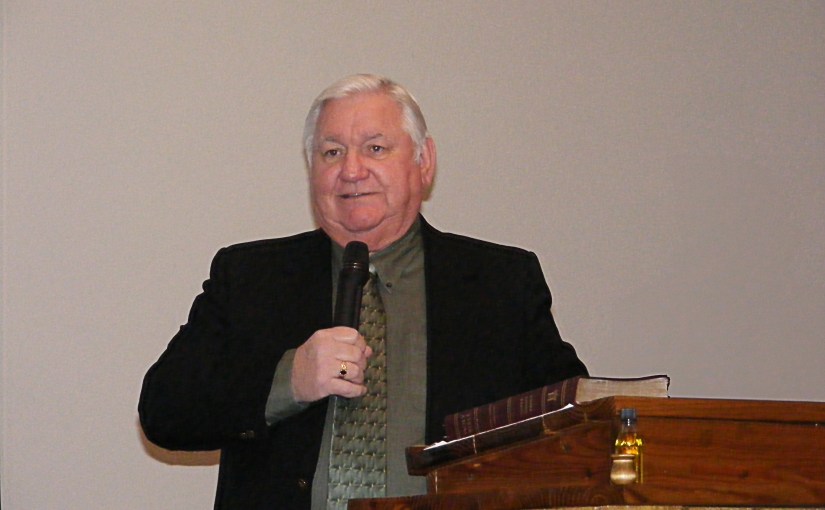
I immediately responded, “I’m his son.” (For those who do not know me in person, I look a lot like my father. In fact, shortly after he passed, there were times that I glimpsed myself reflected in a window or mirror and did a double take, thinking I had seen my dad.)
The gentleman went on to tell me that my “dad was not the biggest. But nobody in town wanted to fight him.”
I recall my dad telling me stories about being an MP in the military and some of the physical altercations he took part in. Those were in the line of duty. Growing up, however, his fights were often for the sake of family. He humorously recounted how he got in more fights protecting his younger brother than anything of his own accord. “Allen would start start something,” he shared, “and then call me.” That sounds like my daddy. All my life if friend or family called in need, he responded.
He was a fighter, not a boxer, although he did step in the ring once. When his family lived in Galveston, one of the Golden Glove boxers in town kept pushing him to box him. Dad finally relented. He said he left the ring thinking the guy had beat him.
The next day, he was walking down the street and saw the boy. Dad prepared to run, but then he noticed that the boy ran first. So of course, Dad chased him. Every time he shared this story he said, “I don’t know what I would’ve done if I had caught him.”
Now, I have not been in a fist fight since I was in high school, though I came close once when I thought I was going to have to defend my children on the street in Nashville. Of course, fist fights are not the types of conflicts in life most of us have as adults, yet Dad’s words hold true in these conflicts, too. I truly avoid conflict when I can. But when it cannot be avoided, I have used Dad’s advice to great advantage.
My dad was a minister most of my life. I grew up in a parsonage and much of my world centered around church. A lot can happen in a church, and all of that is not good. After all, churches are made up of people.
Regarding this, one of the things my father used to say was that “there is no perfect church. And if you find one, don’t join it because you’re not perfect and you’ll ruin it.”
Likewise, he used to add, “people may hurt you, but God never mistreated you.”
Growing up, I saw people who were supposed to be Christians who did not act very Christlike at times. For example, I recall my parents being mistreated through the years by church members, including one who physically assaulted my dad in front of me. I have also had people make unfounded accusations against me when I have worked in church positions. I am sure I am not the only one that could tell these types of stories. But my father’s words still hold true: people, not God, are responsible for these actions and the pain they cause.
After my father was diagnosed with a terminal illness, his comments became more directive and intentional. For example, he told us kids that he had spoiled my mother, and, indeed, he had; furthermore, after he was gone, it was going to be our responsibility to continue spoil her.
We have.
In fact, the transition from him to us started the day he passed away. I received two text messages from him:
“Get me a vanilla milkshake.”
“And your mama one too.”
I did. I brought the milkshakes to their house and spent the last lunch I would ever have with my father.
The December before dad passed away, he gathered all of his kids and grandkids around him at Christmas. He shared what I guess could be called his last sermon. His body was very weak. But his love for the Lord was as strong as ever.
He shared that he knew his life on this earth was coming to an end. He knew this would make us sad. And he did not want to leave us, but it was inevitable. He looked at each of us and said he wanted to see us again, but the only way this would happen was if we each individually accepted Jesus as our Savior: “If you love me and want to see me again, accept Jesus.”
I still carry lots of dad’s words in my head and my heart. But the words from December 2015 are the most poignant and important for me, my kids, and the billions of people on the earth. There is nothing we can do to earn our salvation, no way to be good enough to merit eternal life, but salvation is available through faith Christ alone.
Of all the things he said during the seventy-six years of his life, I think these are the words that my father would most want me to share: “For God so loved the world, that he gave his only begotten Son, that whosoever believeth in him should not perish, but have everlasting life” (John 3:16, KJV).

